
ROBINCAT is a community-driven meme token deployed on Robinhood Chain. Beyond its green-hatted, Robin Hood–inspired feline mascot, the project’s most prominent claim is that holding the token in your wallet automatically earns you USDG stablecoin rewards—no staking, manual claiming, or signature approvals required. However, this is a project promise that requires further verification and should not be equated with a fixed‑yield product. Source: ROBINCAT project page
The contract examined in this article is 0xded852De9fe9bA9b6f27f39e8e81CF851A5C79cc. Before diving into the analysis, three things must be clear: deployment on Robinhood Chain does not mean official issuance by Robinhood; receiving stablecoins does not mean your principal is stable; and the presence of USDG in a trading pool does not mean those funds are reserved for holder rewards.
You can check the ROBINCAT live price for market quotes, but the more critical questions are: who funds the rewards, how long can they last, and how much can you actually get back when selling ROBINCAT?
Research updated: September 4, 2026. This article uses publicly available project pages, official Robinhood and USDG documentation, launchpad platforms, and market snapshots. Reward funding sources and actual distribution records have not been independently verified. All calculations clearly distinguish between real page data and educational assumptions. This is not investment advice or a yield guarantee.
6 Things to Understand Before Investing in ROBINCAT
- ROBINCAT is a community meme asset; the chain name or visual theme does not confer official endorsement.
- Identical tickers can exist on different networks—even on the same chain. Always verify the network and full contract address.
- The project claims automatic USDG distribution, but promotional claims, historical receipts, and sustainable yield are three distinct levels of evidence.
- USDG’s stability does not transfer to your ROBINCAT principal.
- High trading volume does not equal deep exit liquidity; a rising USD‑denominated liquidity value does not necessarily mean fresh capital inflows.
- Until the reward source, distribution rules, and holder eligibility are clear, ROBINCAT should not be treated as a fixed‑income asset.
1. What Is ROBINCAT? First, Identify Which “Cat” You’re Looking At
The trading symbol under review is ROBINCAT, on the Robinhood Chain network. The project page’s listed address matches the one on the Pons launchpad; the Pons page shows a total supply of 1 billion tokens, with a fixed supply at issuance. Source: Pons ROBINCAT page
This helps identify the specific asset but does not substitute for a contract security audit. The webpage says “fixed supply,” but this article has not independently verified that minting, upgrades, admin controls, or transfer restrictions are absent.
Why Does the ROBINCAT Meme Spread So Easily?
The Robin Hood motif, green hat, forest, and cat imagery blend finance, community, and widely recognized cultural symbols. Compared to projects requiring deep technical understanding, this visual package lowers the barrier to sharing.
But virality and investment value are not the same. A memorable image can drive searches and trades, but it alone cannot prove sustainable income, fair valuation, or security.
The origin story—that “Robinhood’s social account first posted a pixelated cat, and an anonymous developer later created the token”—has not been independently verified in this research (original post, first deployment transaction, or timeline). Therefore, it is not treated as evidence of official involvement. The project’s origin narrative and the contract creation record should be verified separately.
2. Is ROBINCAT an Official Robinhood Token?
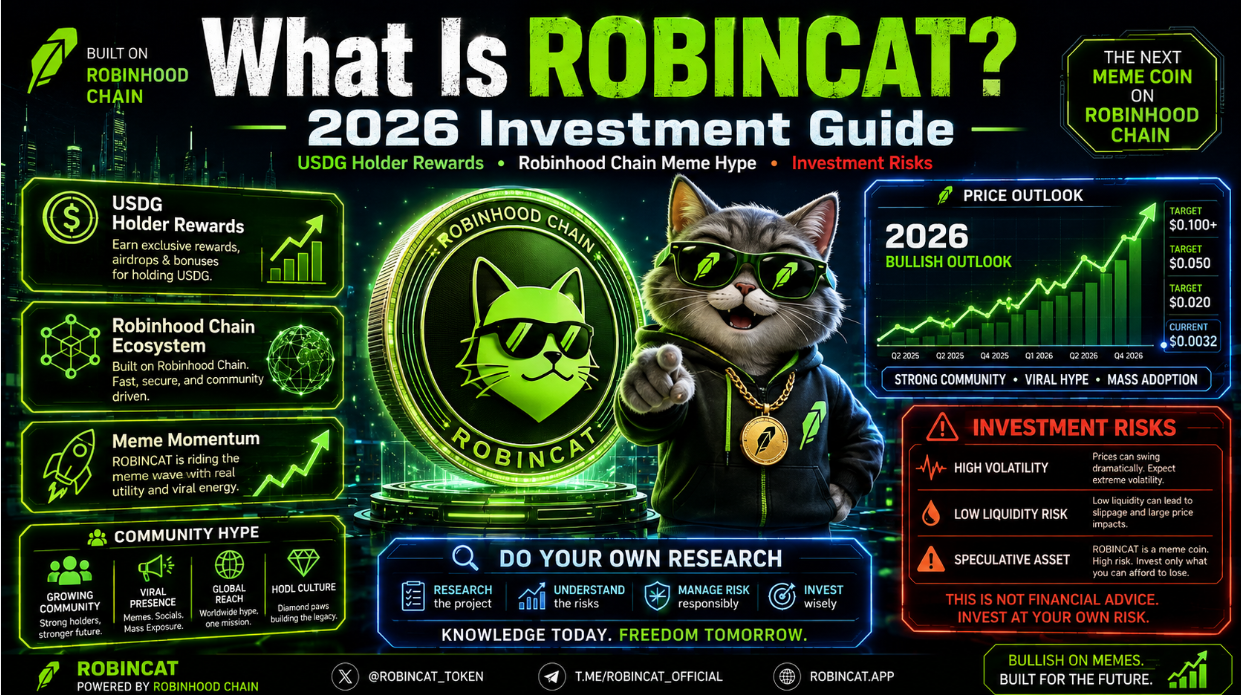
There is insufficient basis to call the token under review an official Robinhood‑issued or guaranteed asset.
Robinhood officially describes Robinhood Chain as a permissionless, Ethereum‑compatible Layer 2. This means the network can host third‑party developers and applications—not only assets launched by the platform itself. Source: Robinhood Chain official docs
Three layers must be distinguished:
- Running on Robinhood Chain: describes the deployment network.
- Using Robinhood‑related imagery: describes the marketing angle.
- Issued or endorsed by Robinhood: requires formal issuance documents or explicit official statements.
The first two do not imply the third. Even if official accounts later retweet, host ecosystem events, or support trading, the scope of that interaction must be verified—it cannot be expanded into a guarantee of token price or rewards.
3. Why Is the Same ROBINCAT Ticker Dangerous? Network, Contract, and Source Are Essential
Names and icons in a ticker list are not an asset’s ID. A duplicate name can be used for any token; the same ticker may exist on different chains, for different projects, or as an impersonation.
Always confirm simultaneously:
First, the network is Robinhood Chain—not a similarly named asset on another chain.
Second, the full contract is:
0xded852De9fe9bA9b6f27f39e8e81CF851A5C79cc
Third, the project page, platform asset description, and block explorer all point to the same address—not just the same icon in search results.
Consistency across these three sources improves identification confidence but still does not prove security. A fake page can copy the correct description and then point the buy button to a different token.
If you’ve already purchased the wrong token, first check your wallet transaction history and the actual received contract. Do not send additional funds because someone DMs you promising to “swap back the real token.” On‑chain transfers are generally not reversible like a mistaken bank wire.
4. What Is USDG? The Reward Coin Is Stable, but That Doesn’t Make ROBINCAT Stable
USDG is the Global Dollar stablecoin. Its official site describes its dollar peg, reserve backing, and applicable redemption mechanics, and lists Robinhood Chain as one of its supported networks. Stablecoins still carry risks related to issuance, reserves, redemption eligibility, and secondary‑market price deviations—they are not unconditional cash deposits. Source: USDG official site
ROBINCAT and USDG are two distinct assets. Even if rewards are indeed paid in USDG, ROBINCAT can still drop significantly.
Also avoid a common misconception: the asset backing of USDG’s issuer supports USDG itself—not every project that uses USDG for rewards. A reward paid in a stablecoin does not prove that the stablecoin issuer partners with that meme project.
You Must Receive Genuine USDG, Not Just a Token Named “USDG”
The official Robinhood contract directory lists the USDG address as:
0x5fc5360D0400a0Fd4f2af552ADD042D716F1d168
When verifying rewards, cross‑check the token contract in your receipt transaction against the official directory—do not rely solely on the name displayed in your wallet. Source: Robinhood contract directory
5. “Hold and Automatically Receive USDG”—What Has Actually Been Verified So Far?
The ROBINCAT project page explicitly claims rewards go directly to holding wallets, with no staking, claiming, or approvals needed, and directs reward‑related announcements to the project’s X account. The readable page does not disclose a verifiable reward wallet, distribution contract, funding source, fixed frequency, or holding threshold. Source: ROBINCAT rewards description
Thus, what can be confirmed at this stage is that “the project is promoting this claim,” not that “all holders have consistently received confirmed yields.”
To assess a reward mechanism, at least four evidence levels are needed:
- Promotion layer: the page says you can earn USDG.
- Receipt layer: actual USDG transfers exist, and receiving addresses qualify.
- Rules layer: explains who gets what, when, and who can change the rules.
- Sustainability layer: the funding source is traceable and can continue paying even after trading cools.
A single receipt screenshot can help verify one payment but does not prove the latter two layers.
Why Doesn’t “Automatic” Mean “Cannot Be Stopped”?
“Automatic” describes the execution method. Even if holders don’t need to click a claim button, distribution may still depend on an operator running a periodic script, refilling the reward wallet, or admin actions.
Therefore, you must also check whether distribution relies on a specific account, whether the service could stop, whether rules are modifiable, and whether failures result in retroactive payments. The absence of a claim button does not imply the entire mechanism is decentralized.
If You Hold on an Exchange, Do You Also Get the Reward?
Not necessarily. Centralized exchange balances are typically recorded in the platform’s internal ledger; the on‑chain address actually holding the tokens may be managed by the exchange in aggregate. Even if that address receives rewards, whether the platform forwards them to users and how eligibility is determined depends on explicit support rules.
Thus, “buying ROBINCAT” and “being a qualified on‑chain reward recipient” must be checked separately. Do not withdraw solely for rewards, and do not assume that leaving tokens on an exchange automatically qualifies you for distributions.
6. Where Do the USDG Rewards Come From? First Ask Who Pays, Then Ask About Yield
Possible Source 1: Transaction‑Related Fees
Some reward tokens accumulate assets through transfer taxes, trading fee splits, or other fee channels, then distribute them to holders. If ROBINCAT uses a similar design, it would require clear fee rates, collection addresses, conversion paths, and allocation percentages.
However, the corresponding Pons page currently shows “0.00% creator tax.” This is insufficient to prove that all transaction paths are completely fee‑free, but it serves as a reminder not to automatically classify ROBINCAT as a “transaction‑tax auto‑dividend project.” Source: Pons launch parameters
Token transfer taxes, DEX trading fees, and creator splits are different concepts. Trades occurring in a pool and fees being paid do not mean those fees all go to ROBINCAT holders.
Possible Source 2: Team or Community Subsidies
If rewards come from a pre‑funded USDG wallet, you should observe its balance and net outflow, rather than extrapolating sustained profitability from distribution amounts.
Teaching example: a reward wallet has 30,000 USDG, spends 1,000 USDG per day, with no new inflows or other costs—at that rate, it can pay for about 30 days. This is a cash‑burn calculation, not an actual ROBINCAT wallet or distribution schedule.
External subsidies are not necessarily invalid, but they must be distinguished from operational income. Consistent reward receipts could simply mean reserves are dwindling.
Possible Source 3: Limited‑Time Campaign or Community Airdrop
If rewards come from a time‑bound campaign, check the end date, snapshot criteria, minimum holdings, excluded addresses, and total budget.
Receipts during a campaign cannot be directly annualized into a permanent APR. This is especially true if rewards are limited to certain addresses, only the top N holders, or buyers within specific time windows—then “all holders earn the same yield” may be entirely false.
The above three categories are possibilities that need to be investigated—they are not confirmations of ROBINCAT’s actual funding source.
7. How to Verify Real Distributions? You Need a Complete On‑Chain Evidence Chain
A useful reward record should include network, USDG contract, transaction hash, block timestamp, sender address, receiver address, amount received, and applicable rules.
Verification should follow this sequence:
First, find the reward wallet or distribution contract publicly identified by the project—do not arbitrarily designate a large address as the project treasury.
Second, confirm the transaction succeeded and that the sent token is indeed the official USDG, not a similarly named asset.
Third, check the receiving address’s ROBINCAT balance at the relevant snapshot time, excluding ordinary transfers, self‑transfers, trade swaps, and LP removals.
Fourth, examine multiple recipients across consecutive time periods to avoid mistaking a single test, small demo, or internal distribution as general yield.
Fifth, trace the funding source of the sending address backward—is it fee income, external top‑ups, or other inflows?
Sixth, verify that the actual amounts match the stated rules. The presence of USDG receipts does not automatically prove fairness or future sustainability.
This research did not obtain a distribution address and transaction sample sufficient to independently verify the above chain. Therefore, no fabricated reward hashes, daily yields, or historical APRs are provided.
The ROBINCAT/USDG Pool Is Not a Reward Vault
USDG in a trading pool is primarily used for trading and liquidity provision. Simply holding ROBINCAT does not entitle you to a proportional share of that pool’s USDG, nor does it mean the entire pool balance can be used for rewards.
Likewise, who earns LP fees depends on the protocol and position rules. Do not conflate trading pool balances, project treasury balances, and distributable reward balances.
8. Why Can Receiving 100 USDG Still Mean Losing Money? Total Return Must Be Calculated Together
Suppose you invest $1,000 to buy ROBINCAT, later receive $100 worth of USDG in rewards, but your ROBINCAT position’s market value drops to $500.
Ignoring fees, your final assets are $600, and your overall return is –40%, not +10%. If you additionally incur $20 in trading, gas, and slippage costs, the final net value is $580, for a –42% overall return.
For a simple case with no additional contributions or partial withdrawals:
Total return = (Ending token value + reward value – associated costs – initial outlay) ÷ initial outlay.
When recording actual results, avoid double‑counting: if the ending asset value already deducts selling fees, do not subtract those fees again.
How Much Price Decline Can the Reward Absorb?
In the above $1,000 principal example, with only $100 in rewards and $20 total costs, the reward can offset at most $80 in principal loss—i.e., an 8% price drop, all else equal.
This is not price protection, nor a stop‑loss guarantee. It simply illustrates that yield claims and principal risk may be in entirely different orders of magnitude.
Historical Reward Rate ≠ Expected Annualized Yield
If you receive $10 in rewards over 7 days, based on a $1,000 initial investment, the observed reward rate is 1%. Multiplying it mechanically by 365÷7 assumes the same result repeats every day—not that the project has committed to that annual yield.
Also, the denominator matters. If the token drops to $500, the same $10 reward becomes 2% relative to current market value—but that does not mean the reward increased; it may simply reflect principal shrinkage.
A more transparent approach is to list the observation period, holding quantity, initial investment, actual rewards, current position value, and costs separately, rather than compressing everything into a flashy APR.
9. Why Is ROBINCAT Trending? Hype and Reward Verification Are Not Interchangeable
Its attention can be broken into three parts: discussions around Robinhood Chain, an easily shareable cat meme, and the “earn stablecoins by holding” narrative. The latter particularly attracts newcomers who may not typically study memes but are drawn to passive income.
However, price increases may simply mean the market is willing to trade on those expectations. That does not prove rewards have been verified, nor that the funding source is sustainable.
At the time of this writing (September 4, 2026), the DEX Screener page for the ROBINCAT/USDG pool showed: price approximately 0.01430, FDV and displayed market cap ~14.3 million, liquidity ~307,000, 24h volume ~9.5 million, and 24h change ~+285%. The page was marked as Uniswap v4. Source: ROBINCAT/USDG pool page
These are snapshots of one pool and one page at a specific time—not unified market closing data, nor causal proof of why the price moved. Rolling changes and quotes will continue to vary.
Do Not Use an Old Report as Today’s Full‑Market Data
The Unhosted report cited in the outline was generated on September 1 and explicitly notes that top‑price data is refreshed independently; it also states a lack of holder growth history. Different modules cannot be stitched into a continuous growth curve. Source: Unhosted report date and limitations
Therefore, this article does not mix old holder counts, liquidity from another time, and current price, nor does it use those fragments to claim that holders have grown by any specific percentage.
10. High Volume and High Market Cap—Why Doesn’t That Guarantee You Can Sell?
From the same pool snapshot, 24h volume was roughly 31× liquidity. This indicates frequent trading relative to pool size, but it does not mean 31× new capital stayed, nor can that ratio alone prove wash trading.
The same capital can trade repeatedly; arbitrage and automated strategies also contribute to volume. More relevant is: how much worse will your average execution price become for the amount you intend to sell?
Why Can’t You Use Total Pool Value to Calculate True Slippage for ROBINCAT?
Uniswap v3 and v4 use concentrated liquidity, where LPs can choose price ranges. The available depth near the current price is not the same as the total USD value of the entire pool. Source: Uniswap concentrated liquidity docs
Real quotes also involve fees, routing, range crossings, and possible pool configurations. Therefore, without obtaining executable quotes, this article does not pretend to have measured real slippage for $1,000, $5,000, $10,000, or $50,000 sell orders.
A Simplified Example to Understand Large‑Sell Impact
Assume a zero‑fee, full‑range constant‑product pool with initial $100,000 on each side; the quoted asset is stable, and no other trades interfere. Selling tokens with a pre‑trade nominal value of S yields quote assets of:
100,000 × S ÷ (100,000 + S).
In this purely pedagogical pool:
- Selling 1,000 nominal → receives ~990.10, ~0.99% less than the initial quote.
- Selling 5,000 → receives ~4,761.90, ~4.76% less.
- Selling 10,000 → receives ~9,090.91, ~9.09% less.
- Selling 50,000 → receives ~33,333.33, ~33.33% less.
These calculations show the average price impact caused by the trade itself—not the slippage tolerance setting in your wallet, and certainly not actual ROBINCAT pool results. The example illustrates that market cap can be large, but exit cost is determined by available depth.
Liquidity Growing May Simply Mean the Token Got More Expensive
If the number of tokens in the pool does not increase but the price rises, the USD‑denominated liquidity value may also increase. To assess whether real capital has been added, check LP additions and removals, the original asset quantities, and whether the same sell‑size quote has improved.
11. How Should You Evaluate Holder Count and Concentration?
This research did not obtain complete, same‑time, independently verifiable holder and related‑wallet data, so it does not adopt numbers like “Top 10 ~ one‑quarter” from the outline that have not been reconfirmed.
When analyzing top addresses, at minimum distinguish exchange wallets, liquidity‑related contracts, reward distribution addresses, project treasury addresses, burn addresses, and ordinary wallets. One exchange address may represent many users; ten ordinary addresses could be controlled by one entity.
Observing changes over time is more informative than a static ranking, but changes also need interpretation: a large transfer could be a sell preparation, a wallet migration, or an LP addition. Do not automatically conclude “team dumping” from any transfer.
For reward‑focused memes, also watch for behavior like splitting wallets to claim rewards, buying temporarily near snapshots, or selling in concert after distributions. These affect reward fairness and what holder growth really means—but this article does not claim to have confirmed such behavior in ROBINCAT.
12. Use a Five‑Factor Framework to Assess ROBINCAT—Not Invent an Investment Score
This article organizes the research into the “HIBT Reward Meme Five‑Factor Framework.” It is an observation checklist, not a backtested model or an investment rating.
1. Reward Source: Who Pays?
This has the highest priority. A public, traceable funding path is required. If the source is unknown, mark it “unverified”—do not give a positive assessment just because the community explanation sounds plausible.
2. Reward Sustainability: How Long Can It Pay?
Examine whether income covers distributions, and whether it relies on short‑term subsidies, peak trading periods, or a constant influx of new buyers. Historical receipts are only a starting point.
3. Liquidity: Can You Exit at an Acceptable Cost?
Look at actual sell quotes for your intended position size, not just total market cap or volume. If rewards are small and exit costs are high, the yield narrative may be practically meaningless.
4. Token Distribution: Who Bears the Price Volatility?
Check the relationships among early wallets, reward recipients, and major sellers. Organic user expansion is more meaningful than an increase in address count.
5. Narrative Sustainability: Beyond Reward Screenshots, What Else?
Observe community content, genuine engagement, and long‑term retention. If the discussion reduces to “how much will we earn next time,” sensitivity to reward interruptions may be higher.
Based on the evidence available, the identity and public reward claims can be cross‑checked, and there is active trading. However, the reward source, sustainability, and full distribution structure remain partially unverified. This state supports continued research but does not warrant a “stable yield” label.
13. ROBINCAT Price Prediction: Give Conditions, Not False Precision
The ROBINCAT price prediction should be used alongside reward verification, market structure, and overall crypto conditions. Short‑history gains cannot support a reliable 2030 target.
Bullish Scenario: Transparent Mechanism Meets Genuine Participation
We would need to see a public reward address and rules, consistent real distributions, a traceable funding source, improved buy/sell depth, healthy holder dispersion, and sustained community interest beyond the first spike.
Even if these conditions are met, re‑assess whether the market cap already prices in those expectations. Transparency does not equal cheapness, nor does it guarantee price appreciation.
Neutral Scenario: Activity Continues, but Hype and Rewards Decline
Trading normalizes, holder growth slows, rewards continue but at reduced amounts—this may indicate a repricing phase. Do not extrapolate one day of launch‑peak distribution to a full year.
Prices may fluctuate widely or drift lower; “community is still here” is insufficient to guarantee a return to previous highs.
Bearish Scenario: Rewards and Exit Capacity Both Weaken
If rewards stop or become less transparent, liquidity persistently exits, volume contracts, large wallets increase selling, and the community relies only on old screenshots, then re‑evaluate your original thesis.
A single missed distribution does not necessarily mean failure—there could be technical or eligibility reasons—but when the lack of explanation, dwindling funds, and weakening market support occur together, the risk assessment must be upgraded.
14. How Should Different Types of Investors Approach This?
Newcomers: Treat Rewards as an Unverified Variable, Not a Safety Cushion
First confirm the contract, holding method, reward eligibility, and exit depth. If you cannot answer “who pays, how is it split, and can I sell,” do not buy impulsively because of price moves or reward screenshots.
If your goal is simply to hold a dollar‑stable asset, buying a volatile meme token should not be seen as a necessary step. Taking principal risk far larger than the reward for a small yield requires an independent justification.
Short‑Term Traders: Write Down Entry, Exit, and Invalidation Conditions
Entry rationale could be sustained volume together with improving depth—not a single green candle. Exit conditions should include position risk, deteriorating depth, and the realization of expectations; invalidation conditions address the mechanism or market assumptions you relied on.
For example, if your entry rationale is “reward transparency will bring sustained new demand,” but later there are only more announcements without funding evidence, your original thesis has not been confirmed. Do not automatically interpret non‑delivery as “just needing more time.”
Position Sizing Should Account for Possible Total Loss
Teaching example: with a $10,000 USDT account, you are willing to lose $100 on this high‑risk experiment. Under a stress test where principal could go to zero, keep the position at or below $100 USDT, also considering fees and actual exit capability.
This is not a recommended ratio. If you build a larger position based on a “stop‑loss at –20%,” acknowledge that gaps, failed transactions, and slippage may cause actual losses to exceed your budget. A stop‑loss price is not a guarantee contract.
Long‑Term Holders: Answer Three Questions
Where does the USDG come from? Does that source continue to exist after trading cools? Why would independent users still want to hold ROBINCAT a year from now?
If you cannot answer all three, a long‑term thesis should not rest solely on “rewards were paid in the past.” Rewards change the cash‑flow form but do not automatically change the risk nature of a meme asset.
15. Why Do BTC and ETH Affect the Environment but Cannot Substitute for ROBINCAT‑Specific Value?
When crypto risk appetite declines, new meme tokens may find weaker demand. Therefore, the BTC price prediction can help build a macro scenario, but it cannot replace ROBINCAT‑specific reward and liquidity research.
Robinhood Chain is an Ethereum‑compatible L2 that uses ETH as gas; the ETH price prediction can offer context from an ecosystem and capital‑flow perspective. But network activity and ETH appreciation do not automatically increase ROBINCAT’s reward wallet income.
BTC, ETH, and ROBINCAT differ in demand drivers, history, and risk profiles. The long‑term investment logic of major assets cannot be copied wholesale to a new meme token that relies on community attention and reward marketing.
16. 10 Risks to Understand Before Trading ROBINCAT
- Same‑ticker risk: Names, symbols, and icons can be duplicated. The wrong contract means buying a different asset.
- Official‑affiliation misinterpretation: Chain name and visual imagery are not issuance or guarantee documents.
- Reward‑source risk: If the funding cannot be traced, payment capacity is unknown.
- Reward‑sustainability risk: Subsidies running out, campaign endings, or declining trading can affect distributions.
- Eligibility and execution risk: Minimum holdings, snapshots, excluded addresses, and platform support rules may affect receipts.
- Liquidity risk: Large exits may face significant price impact; quoted prices are not execution guarantees.
- Concentration risk: Related wallets or early whales may realize holdings during reward‑driven hype.
- Contract and wallet risk: Distribution permissions, upgradeability, malicious approvals, and fake claim pages all warrant caution; this article has not performed a security audit.
- USDG‑related risk: Stablecoins also involve issuance and redemption conditions, and counterfeit contracts or secondary‑market deviations may appear.
- Attention and market risk: Even if rewards remain unchanged, meme capital may flow to the next hot topic; principal loss can far exceed accumulated rewards.
Particularly note: the project currently claims no claim approvals are needed. If someone asks for your seed phrase, private key, or asks you to sign an incomprehensible approval to “unlock USDG,” do not treat that as a normal reward step.
17. Comparing with DELTA, MICRODUCK, MARSCOIN—Look First at the Source of Value
ROBINCAT vs. DELTA: Reward Marketing ≠ Protocol Revenue
The article What Is DELTA discusses liquidity protocol usage, fees, and token value capture. A protocol may have revenue but still needs to prove holders benefit; ROBINCAT must first prove where reward funds come from.
Both may involve “yield,” but the research order is different. Do not mask completely different funding sources under the same APR figure.
ROBINCAT vs. MICRODUCK: Entity Association Is Not Evidence
When reading community‑asset introductions like What Is MICRODUCK, you can apply the same method: is a company name a formal partnership, product adoption, or just narrative borrowing?
For ROBINCAT, “Robinhood + cat + USDG” are three elements that each need separate verification. Name relevance does not imply business relationship; receiving rewards does not mean shareholder dividends.
ROBINCAT vs. MARSCOINUSDT: Distinguish Platform Rewards from Token Rewards
When researching What Is MARSCOINUSDT, first check the trading product and campaign terms. Platform trading activities, spot holdings, and on‑chain holder distributions are different eligibility systems—they cannot be inferred from one another.
The same applies to ROBINCAT: holding the token, participating in trading, and satisfying reward rules may be three different things. Before comparing yields, first confirm the actual risk you take to get the reward.
18. How to Buy ROBINCAT? Complete These 12 Checks First
“ROBINCAT USDT” is just a trading pair quoted in USDT—it does not mean ROBINCAT is fixed to the dollar. Before trading, first verify the platform’s actual support status, applicable jurisdictions, and product type, then complete your account or wallet security setup.
Record the following before placing an order:
- Network confirmed as Robinhood Chain.
- Full ROBINCAT contract matches project and platform descriptions.
- Current quote source and timestamp are clear.
- Market Cap, FDV, and supply use consistent definitions.
- 24h volume is clearly attributed to a specific market or pool.
- Actual buy/sell quotes, fees, and price impact for your planned position are acceptable.
- Volume / liquidity uses the same statistical scope.
- Holder data has a date and comparable methodology.
- Top 10 addresses have been identified by type and relationships where possible.
- Reward wallet or distribution contract has a verifiable source.
- Recent genuine USDG distributions, eligibility, and frequency have been checked.
- Market conditions have been assessed, and maximum acceptable loss is set.
On‑chain trades require ETH for gas—verify approval targets and routing. Centralized‑platform trades require confirmation of deposit/withdrawal and reward‑forwarding rules. Limit orders may not fill; market orders may suffer larger slippage; neither eliminates price risk.
The most important check is not “how much did it gain today?” but: Has USDG actually been distributed recently, who is funding it, and can my principal be withdrawn at an acceptable cost?
19. ROBINCAT FAQs
What coin is ROBINCAT?
It is a community meme token on Robinhood Chain. The project claims that holding it automatically earns USDG rewards. The reward source and sustainability still require independent verification.
Is ROBINCAT officially issued by Robinhood?
No, based on network and imagery alone you cannot conclude official issuance. This research has not obtained any formal issuance or endorsement document that would support that claim.
What is the ROBINCAT contract address?
The address studied in this article is 0xded852De9fe9bA9b6f27f39e8e81CF851A5C79cc on Robinhood Chain. Verifying the address does not complete a security audit.
Why do I see different tokens when searching for ROBINCAT?
Names and tickers can be reused. Always verify the network, contract, and trusted sources to identify the correct asset—do not rely solely on icons or search rankings.
Can I really earn USDG by holding ROBINCAT?
The project’s public page makes that claim, but this research has not independently verified full distribution records, eligibility rules, or funding sources, so no specific holder’s receipt can be guaranteed.
Do USDG rewards come from transaction taxes?
This cannot be confirmed yet. The Pons page shows creator tax as 0.00%, so you should not infer a transaction‑tax dividend model without distinguishing pool fees, creator splits, and other funding sources.
If I receive USDG, am I profitable?
Not necessarily. You must combine principal price changes, rewards, and fees. Rewards may be far from sufficient to offset ROBINCAT’s decline.
Why is ROBINCAT rising?
It may be related to meme virality, reward expectations, Robinhood Chain interest, and short‑term buying. Determining the reason for a specific price move requires transaction and event evidence from that period.
Is ROBINCAT suitable for long‑term holding?
Only after you understand and continuously verify funding sources, demand, and exit capacity can you have a basis for a long‑term thesis. Reward‑alone claims are insufficient to prove long‑term suitability.
What is the biggest risk with ROBINCAT?
Mistaking stablecoin rewards for principal safety. When rewards are opaque, liquidity falls, and concentrated holders sell simultaneously, total losses can escalate quickly.
20. Conclusion: Whether Rewards Can Be Verified Matters More Than the Cat Mascot
ROBINCAT combines Robinhood Chain, a cat meme, and USDG rewards into an easily shareable market story. But truly useful investment research must break that story into verifiable funds, rules, and trading data.
Identity verification answers “what are you buying?”; reward tracing answers “who is paying?”; sustainability analysis answers “how long can it pay?”; exit quotes answer “can you get your principal back?” If any of these four questions is missing, it should not be replaced by a flashy yield number.
Receiving a stablecoin is a cash flow—not insurance on your principal. Only by evaluating rewards together with token price risk, liquidity, and holding eligibility can your ROBINCAT strategy avoid becoming a bet on marketing slogans.