
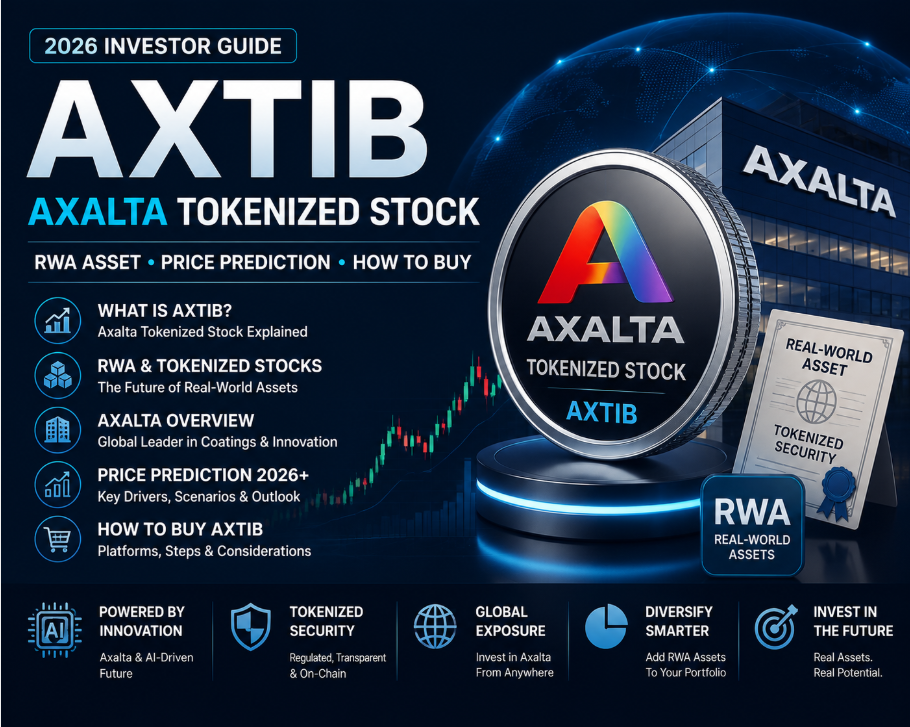
If this is your first time spotting AXTIB on a trading platform, a price ticker, or social media, the most natural question is: What exactly is AXTIB? Is it a new cryptocurrency, or is it tied to Axalta stock?
Simply put, AXTIB is not a public-chain token, a meme coin, or a DeFi governance token in the traditional sense. It is an AXT Tokenized bStock – which falls under the category of Tokenized Stock, i.e., a digital asset that represents equity exposure through blockchain and exchange mechanisms. The core idea isn't "issuing a new coin" but rather transforming Axalta-related equity assets into a form that can be traded within crypto markets.
For newcomers, the most important thing isn't immediately guessing whether it will go up or down – it's first understanding a few basics: How does AXTIB relate to Axalta stock? Is AXTIB actually stock? How is it different from ordinary crypto assets like ETH or BTC? What drives its price? How can a beginner buy AXTIB? And what are the risks?
You can start by checking the AXTIB live price, trading data, and market info on Hibt, then explore the AXTIB price prediction page for market trends and reference forecasts.
1. What Is AXTIB? Why Is Axalta Stock Appearing in Crypto Markets?
When users search "what is AXTIB," what they really want to know is straightforward: Is AXTIB a coin?
The answer is: AXTIB exists as a token, but it is not an ordinary cryptocurrency. More precisely, it is a Tokenized Stock – a digital representation of equity exposure.
According to CoinMarketCap’s description of AXT Tokenized bStocks, AXTIB is a tokenized bStock that provides economic exposure to the underlying security and, where permitted by applicable law, can be converted into the underlying security on Binance.com. The description also notes that each token is backed by corresponding underlying interests held by the issuer with a U.S. regulated broker-dealer.
This means AXTIB is not any of the following:
- A native cryptocurrency like Bitcoin
- A generic project token within the Ethereum ecosystem
- A meme coin driven by community hype
- A governance token for a DeFi protocol
AXTIB is much closer to a tokenized version of a stock asset. It belongs to the RWA (Real World Assets) category. When you buy AXTIB, you are primarily gaining economic exposure to price movements in Axalta-related equity, along with the experience of trading a traditional asset within a crypto environment.
One critical distinction: AXTIB is not the same as buying Axalta stock directly in a traditional brokerage account. It is a tokenized product created through an issuer, a custodian, platform rules, and blockchain technology. What rights you actually receive – whether dividends are included, whether redemptions are supported, and whether conversion to the underlying security is possible – all depend on the specific issuance structure and the exchange’s rules.
2. Is AXTIB a Coin or a Stock?
Many newcomers casually call AXTIB an "AXTIB coin." That’s understandable from a search habit perspective, but it’s not accurate from an asset-class standpoint.
AXTIB is not an ordinary crypto coin – it is a tokenized stock asset.
If you imagine a spectrum with traditional stocks on one end and cryptocurrencies on the other, AXTIB sits right in the middle.
Traditional stocks are characterized by: holding through a brokerage account, regulation by stock exchanges, limited trading hours, and clear equity rights.
Ordinary crypto assets are characterized by: on-chain or exchange-based holding, more flexible trading hours, and prices driven more by crypto-market liquidity, narratives, tokenomics, and community sentiment.
AXTIB combines elements of both. Its value is rooted in traditional equity, but its trading format is closer to crypto.
So instead of asking "Is it a coin?", you should ask:
- What underlying asset does it correspond to?
- Is there real asset custody?
- Does it provide price exposure or full shareholder rights?
- Can it be redeemed or converted?
- In which regions can it be traded?
- Is liquidity sufficient?
These are the real questions for assessing AXTIB’s value and risks.
3. What Is a Tokenized Stock? Why Can Stocks Become Tokens?
Tokenized Stock – as the name suggests – is the concept of taking traditional stocks or their economic rights and mapping them onto blockchain and crypto trading environments via tokens.
Traditional stocks require brokerage accounts, stock exchanges, and conventional clearing systems. Users face restrictions based on account jurisdiction, trading hours, capital requirements, settlement cycles, and market rules.
Tokenized stocks aim to bring equity-like assets onto chains or crypto exchanges, allowing crypto users to access traditional assets in a more familiar way.
As covered in Business Insider’s coverage of a Binance announcement, bStocks are fully supported tokenized securities representing fractional U.S. stocks, issued by BTech Holdings Limited. Eligible users can trade bStocks 24/7, hold them on Binance, self-custody via BNB Chain-compatible wallets, and use them in supported DeFi applications.
That’s the core appeal of Tokenized Stocks:
- Greater trading-hour flexibility – traditional markets have fixed hours, while tokenized stocks often emphasize 24/7 trading.
- Lower barriers for crypto-native users – many crypto users don’t have U.S. brokerage accounts but are already comfortable with USDT, exchanges, wallets, and on-chain assets. Tokenized stocks put equity exposure right into that familiar environment.
- Bridging TradFi and Web3 – in the future, Tokenized Stocks may not only be traded but also used in on-chain portfolio management, DeFi collateral, automated investment tools, cross-chain liquidity, and more.
However, this also introduces new risks. Tokenized Stock is not as simple as "putting a stock on a chain." It involves issuers, custodians, underlying assets, compliance rules, geographic restrictions, platform liquidity, and smart-contract security. Investors shouldn't focus only on convenience – they must also understand the structural risks.
4. What Is Axalta? Why Does AXTIB Merit Attention?
AXTIB is worth studying not because it's a standalone hype token, but because it is linked to Axalta-related equity. So before understanding AXTIB, you need to understand Axalta.
Axalta Coating Systems is a global coatings industry company. According to Axalta’s investor relations page, the company provides coating solutions for light vehicles, commercial vehicles, automotive refinish, electric motors, building facades, and other industrial applications. Its products are used for corrosion protection, productivity enhancement, and durability improvement.
In plain terms, Axalta is not a crypto or AI company – it’s a traditional manufacturing and materials business. Its operations are tied to the automotive supply chain, industrial manufacturing, commercial transport, construction materials, refinish paints, powder coatings, and the global coatings market.
This defines AXTIB’s investment logic: it is not crypto-native growth logic, but rather the price performance of a traditional enterprise value entering crypto markets through tokenization.
- If Axalta’s operations improve, profits rise, market share expands, or industry demand grows, that could support Axalta-related equity and, in turn, influence AXTIB.
- If the auto market declines, industrial demand weakens, raw material costs rise, or competition intensifies, Axalta’s stock may suffer, and AXTIB could be affected as well.
So AXTIB is not an asset that rises on "crypto narrative" alone. Its underlying logic is rooted in traditional manufacturing, materials, and stock-market valuation.
5. Does Investing in AXTIB Equal Investing in Traditional Manufacturing?
In directional terms, yes – AXTIB allows crypto users to gain equity exposure to a traditional manufacturing and materials company like Axalta via token form.
But that does not mean AXTIB is exactly the same as investing in traditional manufacturing stocks.
It involves three layers:
Layer 1 – Axalta’s fundamentals: revenue, profit, margins, cash flow, market share, management strategy, M&A progress, and industry competitiveness.
Layer 2 – Stock-market valuation: even if the company is stable, stock prices are influenced by market sentiment, interest rates, sector valuation, capital flows, and macroeconomics.
Layer 3 – Tokenized trading environment: AXTIB is also affected by crypto liquidity, USDT availability, exchange depth, RWA sector热度, bid-ask spreads, and user demand.
So AXTIB is neither a pure stock nor a pure crypto. It is a hybrid of "stock fundamentals + RWA structure + crypto trading liquidity."
That’s its biggest difference from ordinary crypto assets.
6. Why Is the RWA Sector Gaining Traction?
RWA stands for Real World Assets – the tokenization of real-world assets such as stocks, bonds, gold, real estate, funds, notes, and commodities, bringing them onto blockchains and into crypto markets.
RWA is gaining attention because crypto markets are evolving from purely on-chain assets toward connecting with real-world value.
Early crypto markets mainly traded BTC, ETH, DeFi tokens, GameFi tokens, meme coins, and other on-chain native assets. As the market matures, users increasingly want to bring real assets like U.S. Treasuries, stocks, gold, real estate income rights, and fund shares onto the chain.
The core value of RWA lies in three areas:
- Enhanced liquidity – traditional assets often have limited trading hours, high barriers, and long settlement cycles; tokenization can enable more flexible trading.
- Lower participation thresholds – many tokenized stock or RWA products allow fractional participation, so users don’t need to buy whole shares or full units.
- Bridging TradFi and crypto – RWA allows crypto markets to move beyond purely virtual assets and accommodate price exposure, yield structures, and investment demand from traditional finance.
xStocks’ website similarly describes such products as "stocks on the blockchain," claiming 1:1 backed tokenized U.S. stocks and ETFs with 24/7 trading and cross-chain usability.
AXTIB is a concrete example of this broader trend.
7. How Does AXTIB Tokenized Stock Work? What’s the Underlying Mechanism?
To truly understand AXTIB, you can’t just look at the price chart – you need to grasp the asset structure behind it.
A typical Tokenized Stock structure works like this:
- Real stock or stock-related rights are first held by a custodian or issuance structure.
- The issuer issues tokens backed by those assets.
- The tokens enter the blockchain or exchange system.
- Users hold and trade the tokens via exchanges or on-chain wallets.
- The token price fluctuates around the underlying stock value, market supply/demand, and trading liquidity.
In the bStocks structure, as reported by CryptoBriefing, bStocks are BEP-20 tokens on BNB Chain, issued by BTech Holdings Limited, with each token 1:1 backed by corresponding U.S. stocks held in custody. The report also cautions that such structures are closer to certificates representing financial instruments rather than direct equity.
This is crucial for newcomers. It means AXTIB is related to stock, but it is not common stock in a traditional brokerage account. You should view it as a tokenized expression of a financial instrument, not as direct share ownership.
Therefore, when analyzing AXTIB, you need to consider:
- Is the underlying asset clearly defined?
- Is the issuer reliable?
- Is the custody mechanism transparent?
- Does the exchange support it?
- Are there geographic restrictions?
- Can it be redeemed or converted?
- Is there price deviation?
- Is trading depth sufficient?
If you only look at "it's related to stock" without examining these structural issues, you risk underestimating the risks.
8. How Does AXTIB Relate to Axalta Stock Price?
AXTIB has a price connection to Axalta-related equity, but the two are not always perfectly aligned at every moment.
In theory, if AXTIB is a tokenized stock backed by corresponding underlying shares, its price should track Axalta’s stock value.
In practice, however, AXTIB can be influenced by several additional factors:
- Different trading hours between traditional stock markets and crypto markets may cause short-term pricing lags.
- If AXTIB’s trading depth is thin, bid-ask spreads may widen, causing execution prices to deviate from the underlying reference.
- When crypto markets are highly volatile, users may collectively buy or sell AXTIB based on risk appetite shifts.
- Changes in platform rules, deposits/withdrawals, redemption mechanisms, or geographic restrictions can also affect pricing.
So AXTIB is not a simple "shadow" that copies Axalta’s stock price. It’s more like an expression of Axalta-related equity exposure within a crypto trading environment.
When evaluating AXTIB, you shouldn’t just look at its own candlesticks – you should also track Axalta’s stock performance, company announcements, earnings reports, industry news, RWA sector sentiment, and platform trading depth.
9. What Are AXTIB’s Advantages?
AXTIB’s advantages stem mainly from the Tokenized Stock product format.
1. Crypto-native trading experience – for users already accustomed to USDT trading, AXTIB is easier to understand and use than a traditional brokerage account. You can search for the AXTIB/USDT pair on supported platforms and trade via market or limit orders.
2. More flexible trading hours – traditional stock markets have fixed open/close times, while tokenized stocks typically offer 24/7 trading, which suits global crypto users.
3. Broader asset variety – crypto users used to buy BTC, ETH, altcoins, DeFi tokens, and meme coins. Assets like AXTIB allow them to gain exposure to traditional equity within the same environment.
4. Potential Web3 integration – as the Tokenized Stock ecosystem evolves, these assets may be used in on-chain portfolios, DeFi collateral, automated strategies, RWA index products, and cross-chain applications.
But advantages do not mean zero risk. AXTIB’s convenience relies on the issuer, custodian, exchange, and regulatory framework. Problems in any of these links can affect user experience and asset safety.
10. What’s the Difference Between AXTIB and ETH?
AXTIB and ETH are completely different asset classes.
- ETH is the native asset of the Ethereum network. Its value comes from the Ethereum ecosystem, gas demand, Layer 2 solutions, DeFi, stablecoins, NFTs, RWA onboarding, and developer activity.
- AXTIB is a tokenized stock asset. Its value comes from Axalta-related equity performance, RWA product structure, trading liquidity, and market demand.
ETH is more like infrastructure within the crypto world.
AXTIB is more like an RWA product that brings traditional stock exposure into crypto markets.
- ETH’s risks include public-chain competition, Layer 2 dynamics, regulation, market cycles, and on-chain application activity.
- AXTIB’s risks include Axalta’s business performance, stock-market volatility, issuer risk, custody risk, liquidity risk, and RWA regulatory risk.
So if you’re interested in foundational blockchain assets, you can check Hibt’s ETH price prediction.
If you want to understand how traditional stocks enter crypto markets, AXTIB is a better case study as a Tokenized Stock example.
11. How Does AXTIB Differ from Ordinary Crypto Tokens?
Ordinary crypto tokens typically have their own on-chain ecosystems, protocol functions, governance mechanisms, staking models, community consensus, or tokenomics.
For example:
- ETH represents public-chain infrastructure.
- STORJ represents decentralized storage – you can read what STORJ is to understand how infrastructure tokens build value around real demand.
- PHA leans toward AI/Web3 tech – see what PHA is for AI-blockchain hybrid assets.
- EDU focuses on Web3 education applications – check what EDU is for application-layer tokens.
- BANK is more DeFi-oriented – see what BANK is for financial protocol token value.
AXTIB is different. It does not rely on protocol revenue, chain gas consumption, meme narratives, or DeFi governance. Its core value comes from Axalta-related equity.
In other words, AXTIB is not "a project team made a coin" – it is "an equity asset tokenized and brought into crypto markets."
That is the most important classification difference.
12. Why Does AXTIB’s Price Rise or Fall?
When users search "will AXTIB go up," what they really need to understand is: What drives AXTIB’s price?
AXTIB’s price is influenced by five main factors:
1. Axalta’s fundamentals – revenue growth, profit margins, cost control, market share. Positive developments support valuation; declines hurt.
2. Automotive and industrial cycles – Axalta’s business ties to OEM, refinish, commercial vehicles, industrial coatings, and materials. Auto production, repair demand, industrial investment, construction activity, raw material costs, and global economic conditions all affect market perception.
3. M&A and corporate strategy – the proposed merger with AkzoNobel is a key event. According to AkzoNobel’s announcement, the all-stock merger of equals would give Axalta shareholders 0.6539 AkzoNobel shares per Axalta share. Such major events can affect valuation expectations, future equity structure, synergies, and risk perceptions – and indirectly influence AXTIB.
4. RWA sector sentiment – if the Tokenized Stock market expands, more exchanges support such products, and more users enter via crypto, AXTIB may gain attention. Conversely, if RWA cools, regulation tightens, or demand falls, AXTIB may face liquidity challenges.
5. Crypto market liquidity – even though AXTIB corresponds to equity exposure, it trades in crypto venues. USDT liquidity, exchange depth, overall risk appetite, BTC/ETH trends, and capital flows into RWA sectors all affect short-term price movements.
13. AXTIB Price Prediction: What Should Investors Watch in 2026?
AXTIB price prediction for 2026 cannot rely on candlesticks alone. For this asset class, forecasting should be built on three dimensions: fundamentals, RWA structure, and market liquidity.
Dimension 1 – Axalta stock performance – monitor earnings, revenue growth, gross margins, net income, cash flow, industry competitiveness, customer demand, cost pressures, and strategic moves. If Axalta remains solid and the merger or transformation boosts expectations, AXTIB may find fundamental support. If challenges emerge, it may face headwinds.
Dimension 2 – RWA market development – Tokenized Stock is still relatively new. Its growth depends on exchange support, regulatory clarity, user adoption, issuer transparency, and asset custody quality. If RWA continues to expand, AXTIB may benefit from sector attention. If tokenized stocks face regulatory disputes, issuer credibility crises, or liquidity contraction, AXTIB will be affected.
Dimension 3 – Market liquidity – beginners especially should watch trading volume, bid-ask spreads, order-book depth, and price deviations. If volume is too low, even correct directionality may result in execution difficulties or excessive slippage.
You can check the AXTIB price prediction page for market forecasts and trend references. But remember: predictions are research aids, not guarantees of returns, and never substitute for your own judgment.
A more rational approach:
- First, study Axalta’s fundamentals.
- Then, examine AXTIB’s trading depth.
- Then, assess RWA sector sentiment.
- Finally, decide based on your own position size and risk tolerance.
14. How to Buy AXTIB – A Beginner’s Guide
If you search "How to buy AXTIB," follow these steps:
Step 1 – Find a platform that supports AXTIB. Start with Hibt’s AXTIB/USDT trading page to see live price, market data, and trading info.
Step 2 – Prepare USDT funds. AXTIB is typically paired with USDT. Before buying, decide your investment amount – don’t chase rallies impulsively.
Step 3 – Search for AXTIB/USDT. On the trading interface, search for AXTIB and confirm the trading pair name and asset details to avoid confusing it with similar assets.
Step 4 – Choose your order type. For quick execution, use a market order – but in thin liquidity, market orders may incur slippage. To control your entry price, use a limit order. For new RWA assets like AXTIB, beginners are better off with limit orders to avoid overpaying when depth is shallow.
Step 5 – Manage position size. Don’t ignore crypto volatility just because AXTIB is stock-related. It can still experience significant price swings, especially when volume is low or sentiment shifts.
Step 6 – Set an exit plan. Before buying, decide:
- At what price levels will you take partial profits?
- At what level will you reduce exposure?
- What if liquidity deteriorates?
- What if Axalta or the RWA space undergoes major changes?
Many beginners lose money not because they picked the wrong asset, but because they lacked an exit strategy.
15. What Are the Risks of Investing in AXTIB?
AXTIB’s risks should not be underestimated. It carries stock risk, tokenized-asset risk, and crypto-market environmental risk.
1. Stock market risk – if Axalta’s earnings decline, industry demand weakens, margins shrink, competition intensifies, or the macro environment worsens, AXTIB can fall.
2. Industry cycle risk – Axalta operates in coatings and materials, tied to autos, industrial manufacturing, construction, commercial transport, and the global economy. Economic slowdowns, falling auto sales, reduced industrial investment, and raw material price swings can all affect performance.
3. Tokenization structure risk – AXTIB is not stock in a traditional brokerage account. You must understand the issuer, custodian, asset backing, conversion rules, trading restrictions, and legal applicability.
4. Issuer and custody risk – the long-term viability of Tokenized Stock depends on whether the issuer is sound, custody is transparent, underlying assets are real, and audits/compliance are adequate. Opaque structures increase risk.
5. Liquidity risk – if trading volume is low, bid-ask spreads may widen. In extreme cases, you may not be able to buy or sell at desirable prices.
6. Regulatory risk – tokenized stocks touch on securities laws, and regulations vary by jurisdiction. Users in some regions may be restricted, and rules may change. xStocks’ website also warns that its products are not available to residents of the U.S., U.K., Canada, Australia, or sanctioned jurisdictions, and explicitly notes investment risks and geographic restrictions.
7. Price deviation risk – AXTIB may deviate from Axalta’s reference price in the short term due to supply/demand, exchange depth, time-zone differences, market sentiment, or redemption limitations.
Therefore, AXTIB is not suitable for beginners who have no understanding of equity risk and RWA structures to take large positions.
16. Is AXTIB Worth Investing In? How to Build Your Own Judgment?
"Is AXTIB worth it?" cannot be answered with a simple yes or no. A better approach is to build your own decision framework.
Those who are bullish on AXTIB typically focus on three angles:
- RWA long-term trend – if you believe real-world assets like stocks, bonds, gold, funds, and real estate will increasingly move on-chain, then AXTIB is an interesting sample within Tokenized Stocks.
- Traditional finance moving on-chain – if you think crypto markets will eventually become a new gateway for global asset trading, then AXTIB represents a significant direction.
- Axalta’s company value – if you believe Axalta has lasting competitive strength in coatings, refinish, industrial applications, and global materials, then AXTIB can be a way to study that exposure.
But AXTIB is not for everyone.
- If you only want to invest in BTC and ETH and have no interest in equity assets, AXTIB may not suit you.
- If you don’t understand Axalta’s business and aren’t willing to study fundamentals, AXTIB is not for heavy positions.
- If you can’t accept low liquidity, wide spreads, and tokenization structure risks, avoid blind participation.
- If you’re just chasing short-term pumps rather than understanding RWA logic, AXTIB is not the right choice.
For beginners, AXTIB is better suited for learning, observing, and testing with very small positions – not for large upfront buys.
17. What Indicators Should You Track for AXTIB’s Future Development?
If you want to keep studying AXTIB, monitor three levels:
Company level – Axalta’s earnings, revenue changes, margins, cash flow, debt, customer demand, auto market trends, industrial coatings demand, and M&A progress. Especially the AkzoNobel merger developments, as they may affect market views on Axalta’s future value.
Token level – AXTIB’s circulating supply, trading volume, order depth, bid-ask spread, price deviation, exchange support, and user interest. Rising volume signals growing demand; insufficient depth calls for caution.
RWA industry level – overall Tokenized Stock market size, new tokenized stock cases, exchange support, regulatory policies, institutional participation, and on-chain asset management applications. If the RWA sector continues to grow, AXTIB may become an important educational entry point in Hibt’s RWA content matrix.
18. AXTIB FAQ – Common Questions for Beginners
What is AXTIB?
AXTIB is an AXT Tokenized bStock, belonging to the Tokenized Stock and RWA asset classes. It provides economic exposure to Axalta-related equity via tokens. It is not a public-chain coin, meme coin, or DeFi governance token in the traditional sense.
What is the "AXTIB coin"?
Many search for "AXTIB coin," but more accurately, it is a tokenized stock asset. Though traded as a token, its value logic is closer to equity than to a typical crypto project token.
Is AXTIB the same as Axalta stock?
No. AXTIB is not Axalta common stock held in a traditional brokerage account. It offers exposure to price changes in Axalta-related equity, but whether you have full shareholder rights, dividend rights, or redemption rights depends on the issuer and exchange rules.
How to buy AXTIB?
You can buy through platforms that support AXTIB trading. Beginners can start by visiting the AXTIB/USDT trading page, prepare USDT funds, search for the AXTIB/USDT pair, and then choose a limit or market order based on their risk tolerance.
What affects AXTIB’s price?
AXTIB’s price is primarily influenced by Axalta stock performance, company fundamentals, automotive and industrial cycles, RWA sector sentiment, crypto market liquidity, trading depth, issuer rules, and regulatory policies.
How to read AXTIB price predictions?
Don’t rely solely on candlesticks. Combine Axalta’s earnings, industry cycles, RWA developments, trading volume, and liquidity. You can refer to the AXTIB price prediction page, but remember that predictions are not guarantees.
What’s the difference between AXTIB and ETH?
ETH is Ethereum’s native asset, with value derived from the Ethereum network ecosystem. AXTIB is a tokenized stock asset, with value primarily from Axalta-related equity and RWA trading demand. They are different asset types, not competitors.
Is AXTIB worth investing in?
That depends on whether you are bullish on Axalta’s value, understand the long-term RWA trend, and can tolerate stock volatility and tokenization risks. For beginners, it’s wiser to research first and observe with small positions rather than rushing into heavy allocations.
Conclusion: AXTIB Is Not a Typical New Coin – It’s a Case Study of Traditional Equity Entering Crypto
The core value of AXTIB is not whether it’s a hot new token, but the fact that it represents a new way for traditional stock assets to enter crypto markets.
It connects Axalta – a traditional manufacturing and materials company – to the Tokenized Stock and RWA trend, and bridges traditional finance with crypto trading.
So to understand AXTIB, you can’t use only a "crypto hype" lens, nor only a "traditional stock" lens. More accurately, see it as an RWA product – tokenized equity – traded within crypto markets.
For newcomers, before investing in AXTIB, make sure you can answer five questions:
- What is AXTIB?
- How does it relate to Axalta stock?
- How is it different from ordinary crypto assets like ETH and BTC?
- What drives its price?
- What are the risks?
Once you can answer those, then combine the AXTIB live price, AXTIB price prediction, ETH price prediction, and other educational content for a more comprehensive assessment.
AXTIB isn’t for everyone, but it is an excellent entry point for understanding RWA, Tokenized Stocks, and the broader trend of traditional finance moving on-chain.