
If you first encounter GLWON USDT on a crypto trading platform, you might easily mistake it for a new token called "GLW" — or even think that Corning has entered crypto and issued its own coin.
In reality, GLWON is nothing like an ordinary altcoin.
GLWON is an Ondo tokenized stock asset built around Corning Incorporated's NYSE-listed stock GLW. Its core value derives from the Corning stock traded on the New York Stock Exchange, not from GLWON creating its own independent crypto economy. Market data platforms currently identify GLWON as "Corning (Ondo Tokenized Stock)," and Ondo Stocks' product mechanism gives on-chain tokens economic exposure to the corresponding publicly traded securities.
So before digging into GLWON, you need to separate four distinct concepts:
Corning Incorporated – a U.S. publicly traded materials technology company.
GLW – Corning's ticker symbol on the New York Stock Exchange.
GLWON – the Corning Tokenized Stock product within the Ondo ecosystem.
GLWON/USDT – the trading pair that uses USDT as the quote currency for trading GLWON.
Investors can track the token's market performance via GLWON Real-Time Price & Chart, but the primary long‑term driver of GLWON's price isn't crypto community hype — it's:
How much money Corning will make in the future.
And one of the key reasons Corning has regained market attention in 2026 goes far beyond the "phone glass" many people know — it's a much larger industrial story:
AI data center optical communications infrastructure.
What Is GLWON and Why Isn't It an Ordinary Crypto?
The simplest way to understand GLWON is to view it as:
Tokenized Equity — on‑chain economic exposure to a stock.
Ondo refers to its equity‑like products as Ondo Stocks and uses the on suffix to denote the corresponding on‑chain asset. For example, after a traditional stock is tokenized through Ondo's structure, it becomes a corresponding on‑chain token. Ondo's official documentation states that these tokens aim to track the Total Return of the underlying public securities — meaning they reflect both price changes and the reinvested value of dividends (net of applicable taxes).
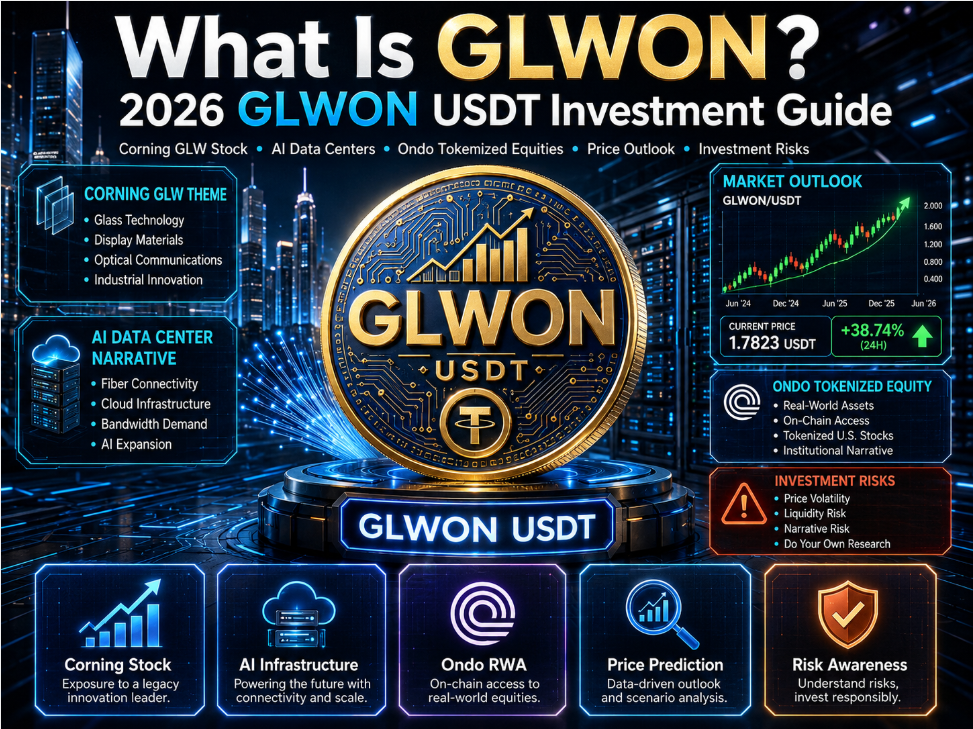
Thus, GLWON's logic can be simplified as:
Corning Incorporated
↓
NYSE: GLW
↓
Ondo Stocks Tokenization
↓
GLWON
↓
On‑chain wallets, trading platforms, and RWA markets
This is fundamentally different from a typical meme coin.
A meme token usually relies on:
- Community
- Culture
- Attention
- Speculative hype
GLWON, on the other hand, ultimately comes back to:
- Corning's revenue
- Profits
- AI data center orders
- Optical communications business
- Consumer electronics
- Valuation
So:
Although GLWON exists as a token, the way to analyze it is much closer to stock investing than to altcoin research.
What Does GLWON/USDT Mean?
If you see:
GLWON/USDT
it simply represents a trading pair.
Where:
- GLWON is the asset being traded
- USDT is the quote currency
If the market shows:
GLWON/USDT = 150
you can roughly interpret that as:
The market is currently willing to trade 1 GLWON for about 150 USDT.
But that does not mean:
- GLWON is a stablecoin
- 150 USDT is a fixed token price that will always correspond to Corning's stock price
For a tokenized stock, it's more important to simultaneously compare:
- GLW stock price
- GLWON reference value
- The actual traded price of the token in the market
We'll explain later why these three prices may diverge in the short term.
Is GLWON Issued by Corning?
No.
This is a critical distinction — just as with many previous tokenized stocks, you need to separate:
The underlying company
from
The token issuance structure.
Corning Incorporated issues the traditional stock GLW.
GLWON belongs to the Ondo Tokenized Stock ecosystem.
So:
- Corning is not "entering the crypto space to issue a coin" by launching GLWON.
- Investors should not think of GLWON as "Corning's official platform token."
What GLWON really leverages is:
Corning's already‑existing public stock value,
and then brings that economic exposure on‑chain through tokenization.
What Is Corning Incorporated? Why Can't You Just Call It a "Phone Glass Company"?
Most everyday consumers know Corning from:
Gorilla Glass.
Many smartphones, tablets, and laptops use Corning Gorilla Glass for screen protection.
So many investors first see GLW and simplistically think:
"It's a phone glass company."
That view is clearly incomplete.
Corning is a materials science company with deep expertise across multiple markets, including:
- Optical Communications
- Display Materials
- Specialty Materials
- Automotive
- Life Sciences
Corning's official business materials show that its Optical Communications segment covers optical fiber, cable, and connectivity solutions; Specialty Materials includes Gorilla Glass and semiconductor optics; Display Technologies covers LCD glass substrates; and Life Sciences includes cell culture, lab consumables, and biopharma research tools.
One important financial reporting change for 2026:
Starting in Q1 2026, Corning adjusted its Segment Reporting — combining the former Display and Specialty Materials into Glass Innovations, and adding a new Solar business segment. The main reporting segments now include Optical Communications, Glass Innovations, Automotive, Solar, and Life Sciences and Emerging Growth Businesses.
So for investment research purposes:
You can still understand Corning through its familiar product areas,
but when analyzing financials, you should use the company's latest segment reporting structure.
Optical Communications: Why Is This Corning's Most Watched Business in 2026?
If you're researching GLWON's current AI investment thesis:
Optical Communications is the core you cannot ignore.
Corning invented low‑loss optical fiber in 1970 and has been a longtime player in global optical communications infrastructure.
It currently provides:
- Optical fiber
- Fiber optic cable
- Connectors
- Data center cabling
- Enterprise networking
- Telecommunications network solutions
In the past, these products were mainly seen as:
Telecom infrastructure.
But in the AI era:
The use cases are expanding significantly.
Large‑scale AI data centers impose enormous demands on:
- Data transmission between GPUs
- Data exchange between servers
- Inter‑rack communication
- Interconnection across data center campuses
This directly positions optical fiber and high‑speed connectivity as:
Part of AI computing infrastructure.
Which Part of Corning Does Gorilla Glass Belong To?
The Gorilla Glass that consumers know best mainly falls under Corning's specialty glass and consumer electronics materials business.
Corning has long supplied protective glass to:
- Smartphones
- Tablets
- Laptops
- Wearables
Therefore, GLW is not a pure AI stock.
Even if the AI data center business grows rapidly:
Corning is still influenced by consumer electronics cycles.
If global:
- Smartphone sales decline
- PC demand weakens
- Replacement cycles lengthen
that can still affect parts of the company's performance.
This is extremely important.
Because many AI‑theme articles tend to make one mistake:
once they see one AI‑related business growing,
they define the entire company as an "AI company."
For Corning, a more accurate assessment is:
A traditional materials technology giant that is gaining an increasingly large AI infrastructure tailwind.
Does the Display Business Still Have Value?
Corning has long been a major supplier of advanced display glass worldwide.
Display glass is widely used in:
- Televisions
- Monitors
- Laptops
- Other panel devices
Although the 2026 financial reporting has merged the former Display and Specialty Materials into Glass Innovations, display materials remain an important part of Corning's business.
So when researching GLW, you can't just look at:
AI.
You also need to consider:
- LCD and display panel cycles
- Consumer electronics demand
- Glass pricing
- Manufacturing efficiency
Why Is Life Sciences Also Part of Corning?
Corning also has a well‑established Life Sciences business.
Its products cover:
- Cell culture
- Lab consumables
- Biopharmaceuticals
- Drug discovery
- Genomics research
This means:
When you buy GLWON, you are not buying a single‑theme "AI fiber token."
The economic exposure you actually gain comes from:
The entire Corning Incorporated.
AI optical communications is just one of the most notable incremental variables right now.
Why Is Corning Suddenly Linked to AI Data Centers in 2026?
Many investors may still wonder:
Corning makes glass and optical fiber.
AI is about GPUs, chips, and large language models.
Why would they be related?
The answer lies in this:
AI doesn't just need computation; it also needs transmission.
Training large AI models is not a single GPU working alone.
Today's large‑scale AI infrastructure requires:
- Thousands
- Tens of thousands
- or even more GPUs
forming massive compute clusters.
GPUs constantly need to exchange data with each other.
So the chain becomes:
AI models grow larger
↓
GPU cluster sizes increase
↓
Server and switch counts rise
↓
Data transmission volume surges
↓
Network bandwidth requirements increase
↓
Demand for optical fiber and high‑speed optical connectivity rises
↓
Corning's Optical Communications business gains new market opportunities.
This is the underlying industry logic behind Corning's current AI narrative.
Is Corning's AI Growth Just "Conceptual Hype"?
Looking at the financial data already disclosed in 2026, it cannot be simply dismissed as market hype.
In Q2 2026, Corning reported:
- Core Sales increased 17% year‑over‑year to $4.74 billion
- Optical Communications sales grew 32% to $2.072 billion
- Within that, Enterprise Networks grew 65%, and the company specifically noted that Gen AI‑related product sales grew at a significantly faster pace
This data is critical.
Because it shows that:
AI data center demand has already begun to show up in:
Actual revenue growth.
This is different from companies that only have a "future potential in AI" narrative.
For GLW investors, the next key question becomes:
Can this growth be sustained?
Can margins improve?
Will expanded production capacity be absorbed by orders?
Why Is the NVIDIA and Corning Partnership Worth Watching?
In May 2026, Corning and NVIDIA announced a multi‑year commercial and technical collaboration.
According to the joint announcement, Corning plans to increase its U.S. optical connectivity manufacturing capacity by 10x, expand its U.S. optical fiber production capacity by more than 50%, and build three new manufacturing plants to meet the high‑speed connectivity demand driven by AI Factory builds.
This partnership is highly symbolic.
Because NVIDIA addresses:
GPU computing power.
Corning's role is:
How to efficiently connect those GPU clusters.
In modern AI data centers, the more GPUs you have:
the more important the network becomes.
If the network becomes a bottleneck:
even if GPUs are extremely fast,
the overall AI cluster utilization suffers.
Thus:
AI infrastructure investment is expanding from:
GPU
to:
GPU + Networking + Optical Communications + Power + Data Centers.
Corning sits squarely in:
the optical communications segment.
What Does Meta's $6 Billion Agreement With Corning Mean?
In January 2026, Corning also announced a multi‑year agreement with Meta worth up to $6 billion, to supply next‑generation optical fiber, cable, and connectivity products for Meta's U.S. data center builds.
This further confirms that:
Corning's AI data center business does not rely on a single customer or a single technology concept.
Meta needs to expand its AI data centers.
NVIDIA needs to build larger AI compute clusters.
Both ultimately generate:
high‑speed data transmission needs.
That increases:
- Fiber density
- Connection counts
- Bandwidth within and between data center campuses
This is why Corning is considered a "pick‑and‑shovel" AI asset.
It doesn't sell AI models directly.
Instead:
It provides critical materials and connectivity technology to those building AI infrastructure.
Why Could Co‑Packaged Optics Become Corning's Next‑Stage AI Story?
One important technological direction for the further evolution of AI networks is:
CPO — Co‑Packaged Optics.
In traditional data centers:
after optical signals reach the switch,
they often need to travel through electrical connections to the chip.
As bandwidth continues to rise:
copper connections face challenges with:
- Power consumption
- Signal integrity
- Space
- Heat dissipation
CPO's approach is to:
bring optical components closer to the chip,
moving toward a "fiber‑to‑chip" architecture.
Corning introduced and demonstrated in 2026:
- Multi‑core fiber
- Micro Cable
- Next‑gen high‑density connectors
- CPO systems
and other products aimed at AI networking.
So GLW's AI investment thesis is now developing on two levels:
Level 1:
AI data center construction increases traditional fiber and connectivity demand.
Level 2:
AI network architecture upgrades could drive demand for more advanced optical connectivity like CPO and fiber‑to‑chip.
If Level 2 truly scales:
Corning could gain access to a new, higher‑value market.
How Does GLWON Bring GLW Stock Onto the Blockchain?
Once you understand Corning's fundamentals, GLWON becomes much easier to grasp.
Ondo Stocks' basic model can be simplified as:
GLW Stock
↓
Traditional securities markets and Broker/Custody systems
↓
Ondo Global Markets
↓
Token Issuance
↓
GLWON
Ondo's official materials state that its Tokenized Stocks aim to give token holders economic exposure similar to the underlying public securities, and that mechanisms like Mint, Redemption, and the liquidity of traditional securities markets help reduce price divergence between the token and the underlying asset.
Therefore:
GLWON itself does not need to operate an "on‑chain fiber company."
Its value source remains:
Corning.
Why Can GLWON Track GLW's Price?
For a tokenized stock to function properly, one core issue must be addressed:
Why won't the token price permanently diverge from the stock?
One key mechanism is:
Mint / Redemption.
Assume GLWON's market price is significantly above its fair reference value.
Eligible participants may mint new tokens through the issuance mechanism and sell them on the secondary market.
The increased token supply helps to:
push down the premium.
Conversely:
If GLWON trades well below its reference value,
arbitrage participants may:
buy the discounted token,
perform a Redemption,
and profit from the price difference.
Ondo explicitly states that its low‑cost Mint/Redemption mechanisms, combined with inherited liquidity from traditional markets, are designed to help arbitrageurs correct price dislocations more quickly.
So:
There is a price‑linking mechanism between the stock market and the token market.
But that does not mean:
they are equal every second.
Can GLWON Be Traded 24/7?
Here we need to distinguish between two concepts:
Token trading and transfer
versus
Official Mint / Redemption.
Ondo's documentation indicates that its Tokenized Stocks generally offer 24/5 Mint and Redemption, while the on‑chain tokens themselves can be transferred peer‑to‑peer 24/7. However, corporate actions, market volatility, or systematic risk controls may temporarily suspend Mint/Redemption.
Therefore:
It is still possible to see on‑chain GLWON trading during:
- After‑hours U.S. stock market
- Weekends
- Holidays
But this also creates a risk:
The traditional GLW spot market may be closed.
That's why tokenized stocks often experience:
- Premiums
- Discounts
- Price deviations
during off‑hours.
Does Holding GLWON Equal Holding GLW Stock?
Not exactly.
Ondo's legal disclosures clearly state:
Global Markets Tokens provide economic exposure to the value of the underlying public assets, including dividend value net of applicable taxes; however, the Tokens themselves are not stocks or ETFs, and token holders do not have the right to directly claim the underlying securities.
So:
Buying GLWON
and
buying GLW through a brokerage account
are two different asset structures.
What Does "Economic Exposure" Mean?
Suppose Corning stock goes from:
$100
to:
$120.
If GLWON properly tracks GLW:
GLWON's economic value should theoretically increase accordingly.
So you gain:
the opportunity to benefit from Corning's stock price appreciation.
But you hold:
a token.
Rather than directly holding one share of GLW in a traditional securities account.
You can think of it as:
Traditional stock:
Investor → Broker → GLW Share
GLWON:
Investor → GLWON Token → Ondo Product Structure → GLW Economic Exposure
There is an extra layer:
the Tokenization structure.
That's also why GLWON carries not only Corning's own risks,
but also additional risks from:
- Issuance structure
- Custody
- On‑chain infrastructure
- Liquidity
etc.
Does GLWON Pay Dividends?
Ondo Stocks use a Total Return Tracker mechanism.
The official explanation is:
the token aims to track not only the price changes of the underlying stock, but also reinvests the dividend value (net of applicable withholding taxes) back into the underlying assets.
So GLWON cannot be understood simplistically as:
"GLW pays $X cash per share, so my wallet directly receives that same cash."
More accurately:
Dividend value is incorporated into the token's Total Return.
Does GLWON Have Voting Rights?
This is another area where you can't rely on absolute statements often found in older tokenized stock articles.
In April 2026, Ondo announced a partnership with Broadridge enabling holders of more than 250 tokenized stocks and ETFs to submit Voting Preferences for the underlying securities, and to access prospectuses, regulatory disclosures, and governance information.
However, we still need to distinguish:
expressing a Voting Preference through the tokenization mechanism
from
direct registered ownership in a traditional brokerage account.
Ondo's legal disclosures still clearly state:
Global Markets Tokens are not the underlying stocks themselves.
Thus:
The governance experience is improving, but the legal structure of the asset remains different.
Why Is GLWON Considered an RWA?
RWA stands for:
Real World Assets.
The core idea is:
bridging the value of real‑world assets with blockchain.
Examples include:
- U.S. Treasuries
- Gold
- Real estate
- Stocks
- ETFs
- Private credit
GLWON's underlying economic value comes from:
Corning stock GLW, which trades in real‑world securities markets.
So it belongs to:
Tokenized Equity / Tokenized Stock RWA.
That's also its biggest difference from ETH.
What's the Fundamental Difference Between GLWON and ETH?
ETH is a Crypto Native Asset.
Its value derives more from:
- The Ethereum network
- Gas fees
- DeFi
- Stablecoins
- Layer 2
- Staking
If you want to study Ethereum's long‑term market cycles, you can refer to ETH Price Prediction and Ethereum Market Trends.
GLWON is different.
Its value logic is much more direct:
Corning's operational performance
↓
GLW stock valuation
↓
GLWON economic value.
So researching GLWON:
does not require heavy focus on:
- Meme propagation
- Community shilling
- Crypto KOLs
Instead, you should research:
- Corning's financial reports
- AI data centers
- Optical Communications
- Company profits
- U.S. stock valuations
Why Does GLWON Price Rise? 7 Factors That Truly Determine Price
GLWON is not a token you can analyze in isolation.
You need to monitor at least seven variables simultaneously.
First: Corning Stock GLW
This is the most important price variable.
If GLW stock keeps rising:
under normal circumstances, GLWON's reference economic value should also rise.
If GLW drops significantly:
GLWON will find it hard to sustain an independent rally.
So:
Any GLWON price prediction should start with GLW.
Second: AI Data Center Capital Expenditure
In 2026, Corning's biggest new investment thesis comes from:
AI infrastructure.
Investors should keep an eye on:
- Microsoft
- Meta
- Amazon
- Oracle
- Other hyperscalers'
data center CAPEX.
If global AI giants continue to:
- expand GPU clusters
- build AI Factories
- increase network bandwidth
that will boost demand for:
- Optical fiber
- Fiber optic cable
- High‑density connectivity
- Optical components
Corning's major partnerships with NVIDIA and Meta announced in 2026 already reflect this trend.
Third: Optical Communications Revenue
This is the key metric to determine whether Corning's AI thesis is actually playing out.
Not:
how many times "AI" appears in the news.
But:
whether AI demand has ultimately translated into revenue.
In Q2 2026, Corning's Optical Communications sales reached $2.072 billion, up 32% year‑over‑year; Enterprise Networks grew 65%, with Gen AI‑related products growing even faster.
If we continue to see in the coming quarters:
- revenue growth
- order growth
- margin improvement
the market may assign a higher AI infrastructure valuation to Corning.
If growth starts to slow meaningfully:
the market may re‑price accordingly.
Fourth: Consumer Electronics Cycles
Corning is still influenced by demand for:
- Smartphones
- Tablets
- Laptops
- Televisions
- Monitors
So even if AI data centers perform well:
weakness in traditional consumer electronics could offset part of the growth.
This is the portfolio effect you must consider when analyzing a diversified materials company.
Fifth: Corning Quarterly Earnings
When investing in GLWON, the dates truly worth marking on your calendar are not crypto AMAs.
They are:
Corning Earnings Dates.
Key metrics to watch:
- Revenue
- Core EPS
- Margin
- Free Cash Flow
- Optical Communications
- Glass Innovations
- Capital Expenditure
- Management Guidance
In Q2 2026, Corning's Core Sales grew 17% year‑over‑year and Core EPS grew 30%, indicating that current growth is not limited to a single sales metric.
Sixth: U.S. Interest Rates and Stock Valuations
GLW is ultimately a U.S.‑listed stock.
If:
- interest rates decline
- markets are risk‑on
- growth and technology infrastructure assets command higher multiples
GLW may receive a higher valuation multiple.
Conversely:
if rates stay high for an extended period,
and overall U.S. equity valuations contract,
even if Corning's earnings continue to grow:
the stock price may still suffer from multiple compression.
So:
Good earnings do not mean any valuation is a buy.
Seventh: GLWON's Own Liquidity
Even if GLW doesn't move:
GLWON can still experience volatility due to secondary market structure.
Including:
- low trading volume
- thin order books
- wide bid/ask spreads
- Mint/Redemption suspensions
- weekend trading
- sudden spikes in token demand
So researching GLWON cannot stop at:
the Underlying.
You must also research:
the Token Market.
Why Can GLWON Diverge From GLW?
This is one of the most important — and most overlooked — issues for tokenized stocks.
Under normal conditions:
GLWON should trade around GLW's corresponding economic value.
But in practice, there are at least three price concepts.
First:
GLW stock spot price.
Second:
GLWON's reference economic value.
Third:
The actual traded price of GLWON on a particular trading platform.
The third price can deviate from the second in the short term.
What Is a GLWON Premium?
A simplified example.
Assume that after applying the token structure, the fair reference value for GLWON is about:
$150.
But on a particular crypto exchange, due to heavy buying:
the actual traded price reaches:
$156.
That would represent approximately:
a 4% Premium.
At that point, investors need to answer two completely different questions:
Is Corning a company worth investing in?
and
Am I currently paying an extra 4% premium just to buy GLWON?
Even if the answer to the first question is:
Yes.
The second question could still be:
that price is unreasonable.
What Is a GLWON Discount?
Conversely:
reference value $150.
Token market only:
$144.
That implies about:
a 4% Discount.
A discount might arise from:
- low liquidity
- sell pressure
- panic selling
- Mint/Redemption restrictions
- time‑zone trading differences
If arbitrage channels are functioning normally:
arbitrageurs may help push the token back toward its reference value.
Ondo's Mint/Redemption design is itself intended to reduce such price dislocations by leveraging traditional market liquidity.
But:
Arbitrage is not risk‑free and instantaneous.
So short‑term price gaps can still persist.
Why Is GLWON More Notable on Weekends?
GLW stock is not traded 24/7.
But on‑chain tokens can continue to be transferred and traded in certain venues.
Suppose on a Saturday, unexpected news breaks:
- Corning lands a large AI order
- NVIDIA expands procurement
- Major U.S. policy announcement
- or a negative event hits the company
GLW traditional stock cannot perform price discovery on the NYSE until Monday.
However:
the GLWON secondary market may trade on that news first.
So you might see:
Token market prices in the news first → U.S. market opens Monday → the two markets converge.
Under such circumstances:
weekend GLWON prices can carry significantly more uncertainty.
How to Invest in GLWON in 2026?
For tokenized stocks, the most important step is not:
"which button to click."
It's:
completing your research before buying.
Step 1: Research Corning First, Not GLWON's Chart
At minimum, answer:
What does Corning do?
Why is AI data center revenue growing?
How important is Optical Communications?
What is GLW's current valuation?
How did the latest earnings perform?
If you don't know the answers to these questions,
and you buy simply because:
"GLWON has been rising recently,"
you are still essentially chasing momentum.
Step 2: Check the GLWON Market
You can view GLWON Real‑Time Price and Historical Trends to see:
- Latest price
- 24‑hour change
- Volume
- Historical candlesticks
But for a tokenized stock:
this is only the first layer of market data.
The next step is still to:
compare GLW.
Step 3: Prepare USDT
If the platform uses the:
GLWON/USDT
trading pair,
it means you use USDT as the transaction and settlement currency.
This does not change GLWON's underlying stock nature.
USDT is simply:
the trading currency.
Step 4: Compare GLW and GLWON
This is the most important extra step when buying a tokenized stock.
When buying BTC:
you don't need to compare to a "real BTC stock."
But when buying GLWON:
you should simultaneously check:
- GLW stock price
- Token reference value
- GLWON actual traded price
If the token already carries a noticeable Premium:
you need to reconsider the Risk/Reward.
Step 5: Choose Limit Order vs. Market Order
For markets with relatively limited liquidity:
a Limit Order usually gives you better control over:
the execution price.
A Market Order has the advantage of:
fast execution.
But the downside is:
the actual price is affected by order book depth.
Especially for larger trades:
you may experience significant Slippage.
So:
good liquidity in the underlying U.S. stock
does not mean all GLWON trading platforms have equally deep order books.
Step 6: Manage Position Size
A common misconception is:
"This is a U.S. stock token, so it must be safer than crypto."
That assumption does not hold.
GLWON carries at least the following risks simultaneously:
- GLW stock risk
- Ondo product structure risk
- Token market liquidity risk
- Platform risk
- Regulatory risk
So when participating in tokenized stocks for the first time:
you should still control your position size.
How to Read GLWON Price Predictions?
If you want to predict GLWON:
the most important thing is not to predict the token directly.
It is:
predict Corning's future earnings and GLW's valuation.
You can use GLWON Price Prediction and Trend Analysis to observe historical price models, but it is not advisable to simply adopt fixed‑number predictions like:
"$XXX in 2027"
"$XXX in 2030"
A more reasonable approach is to consider:
Bull Case, Base Case, Bear Case.
GLWON Bull Case: AI Data Centers Become a Long‑Term Growth Engine
An optimistic scenario might require:
- Hyperscalers continue to expand AI CAPEX
- NVIDIA GPU clusters keep growing
- AI Factory construction increases
- Optical connectivity demand rises
- Corning's Optical Communications maintains strong growth
- CPO gradually enters large‑scale deployment
- Overall company margins improve
Corning has already expanded U.S. optical connectivity manufacturing capacity through its NVIDIA partnership and gained large data center demand exposure through the Meta multi‑year agreement.
If these trends further materialize:
the market may assign a higher growth multiple to GLW.
GLWON would then likely benefit in tandem.
GLWON Base Case: AI Grows, but Traditional Businesses Partially Offset
A neutral scenario could be:
AI optical communications continues to grow.
But:
- smartphone growth is limited
- display business is mediocre
- automotive or other segments are flat
Ultimately Corning overall still grows,
but without extreme AI valuation expansion.
In that case:
GLW may be priced more as:
a steady‑growth materials technology company.
GLWON would track the underlying value accordingly.
GLWON Bear Case: AI Capital Expenditure Slows
A risk scenario might involve:
- large tech companies reducing AI CAPEX
- GPU cluster expansion slowing
- optical connectivity demand growth decelerating
- CPO adoption slower than expected
- consumer electronics weakness
- margins disappointing the market
- U.S. stock valuations declining
In that situation:
even if the "AI long‑term trend" remains intact,
GLW could still experience significant valuation compression in the short term.
That's why:
A correct long‑term industry trend does not mean a stock will go up forever.
The Core Formula for GLWON Price Prediction
You can think of GLWON's long‑term price logic as:
GLWON Value ≈ Corning Earnings × GLW Valuation × AI/Traditional Business Cycle × Token Tracking Efficiency × Premium/Discount.
This is not a strict mathematical formula.
Its main purpose is:
to prevent investors from treating GLWON as an ordinary crypto token.
If Bitcoin Rises, Will GLWON Definitely Rise?
Not necessarily.
You cannot even establish a simple proportional relationship.
A 10% rise in Bitcoin:
does not mean GLWON rises 10%.
Because GLWON's underlying is:
Corning stock GLW.
The main drivers are:
- U.S. stock market conditions
- Corning earnings
- AI data centers
- Optical communications demand
- Company valuation
You can observe the overall crypto risk‑on environment via BTC Price Prediction and Bitcoin Market Cycles.
A strong BTC could indirectly bring:
- more USDT liquidity
- increased RWA trading activity
- improved on‑chain risk appetite
But that is a:
Secondary Effect.
GLWON ultimately still needs to come back to:
GLW.
What's the Difference Between GLWON and PLTRON?
If you want to build an AI asset portfolio, you can compare GLWON with other tokenized stocks.
For example, What Is PLTRON USDT? Palantir Tokenized Stock and AI Data Analytics Investment Logic.
PLTRON leans more toward:
- AI software
- Enterprise data analytics
- Government business
- Software platforms
GLWON leans more toward:
- Optical fiber
- Data center connectivity
- AI infrastructure hardware
In simple terms:
PLTRON makes money in the higher‑layer software applications.
GLWON's underlying Corning is:
making the AI infrastructure actually connect.
What's the Difference Between GLWON and INTCON?
Semiconductor‑related assets represent another layer of the AI supply chain.
You can read further: What Is INTCON? Semiconductor Tokenized Stock Investment Logic.
Semiconductor companies focus more on:
- Chip performance
- Process technology
- Production capacity
- Server demand
- AI computing
Corning focuses on:
- Optical fiber
- Connectors
- CPO
- Data center networking
So:
Chips do the computing.
Optical communications do the transmitting.
Both can benefit from AI, but their investment theses are different.
What's the Difference Between GLWON and QQQON?
If you don't want to bet on:
a single Corning company,
index‑based tokenized assets offer more diversification.
You can refer to: What Is QQQON USDT? Nasdaq Technology ETF Tokenized Investment Analysis.
QQQON is closer to:
a portfolio of large tech companies.
GLWON is a:
Single Stock Exposure.
Therefore GLWON carries more pronounced:
Company‑Specific Risk.
A single Corning earnings report can significantly move the price.
Index products diversify risk across multiple companies.
What's the Difference Between GLWON and METAON?
Meta is an important AI data center customer for Corning, and METAON itself represents another tokenized stock investment direction.
You can read further: What Is METAON USDT? Meta Tokenized Stock and AI Investment Logic.
META relies more on:
- Advertising
- AI platforms
- Social networks
- Large language models
- Data center investment
Corning, in turn, can benefit from Meta's capital spending through:
fiber and connectivity orders.
So the two even form an interesting industrial relationship:
META invests in AI infrastructure
↓
Builds data centers
↓
Buys more optical communications products
↓
Corning generates revenue
↓
GLW fundamentals improve
↓
GLWON gains economic exposure.
The multi‑year agreement between Corning and Meta announced in 2026, worth up to $6 billion, makes this industrial chain relationship even more concrete.
How to Place GLWON, PLTRON, INTCON, METAON, and QQQON Along One AI Value Chain?
You can build this framework:
METAON
AI platforms, internet, and AI applications
↓
PLTRON
AI software and data analytics
↓
INTCON
Semiconductors and computing hardware
↓
GLWON
Optical communications, data center connectivity infrastructure
↓
QQQON
Portfolio of large‑cap tech assets.
This is more meaningful than simply comparing:
"which token has risen more."
Because what you are truly choosing is:
different segments of the AI value chain.
Is GLWON Suitable for Long‑Term Investment?
You need to distinguish between:
being bullish on Corning
and
being suitable to hold GLWON.
They are not completely the same.
Which Type of Investor Should Research GLWON?
Type 1:
Bullish on AI data center infrastructure.
Type 2:
Bullish on long‑term optical communications upgrades.
Type 3:
Want to gain U.S. stock economic exposure through on‑chain means.
Type 4:
Already understand RWA and tokenized stock structures.
Type 5:
Willing to continuously track Corning's earnings.
If you fall into these categories:
GLWON is worth researching.
Which Type of Investor Might Prefer Buying GLW Directly?
If you already have a mature U.S. brokerage account,
and you place more importance on:
- traditional securities legal structure
- direct stock holding
- deep stock liquidity
- traditional brokerage services
then buying GLW directly is probably a simpler approach.
Because a tokenized stock adds extra layers:
- issuer
- custodian
- smart contract
- on‑chain market
- redemption
etc.
Who Is Not Suited for GLWON?
If an investor's entire research consists only of:
"GLWON is a new coin."
"AI is hot right now."
"Will the price double again?"
then they probably have not truly understood what they are buying.
GLWON is not a typical:
New Coin Narrative.
The correct research sequence should be:
Corning
↓
GLW
↓
Ondo
↓
GLWON.
Not the reverse.
9 Major Risks You Must Know Before Investing in GLWON
One of the biggest misconceptions about tokenized stocks is:
"It has real U.S. stock backing, so it's very safe."
In reality:
it merely changes the risk structure.
Risk 1: Corning Fundamental Risk
If Corning:
- revenue declines
- profits miss expectations
- major orders shrink
- costs rise
GLW stock can fall.
GLWON would be similarly affected.
Risk 2: GLW Stock Volatility Risk
Tokenization does not eliminate stock risk.
Even if Ondo's product mechanism works perfectly:
if GLW drops 30%,
GLWON is likely to suffer a corresponding economic loss.
So:
GLWON is by no means a stablecoin.
Risk 3: AI Capital Expenditure Cycles
Corning in 2026 is clearly benefiting from:
Gen AI data center investment.
But AI CAPEX is not guaranteed to grow at high speed forever.
If hyperscalers cut capital spending in the future:
order growth in related segments may slow.
The market may also lower GLW's AI valuation.
Risk 4: Competition in Optical Communications
AI optical communications is a highly competitive industry.
Corning must continuously face:
- technology upgrades
- product pricing
- customer concentration
- alternative solutions
- pressure from other optical communications vendors
CPO, despite its huge potential:
still carries uncertainty regarding the pace of technology adoption.
Risk 5: Token Issuance Structure Risk
GLWON is not GLW stock itself.
Ondo's legal disclosures clearly state:
Global Markets Tokens provide economic exposure, but Tokens are not the underlying stocks, nor do they grant holders a direct right to claim the underlying securities.
This means:
investors also need to understand the issuance structure.
Risk 6: Underlying Asset and Custody Infrastructure Risk
Tokenized stocks need to connect:
- Traditional brokers
- Custody
- Token Issuer
- Blockchain Infrastructure
- Smart Contracts
Compared to direct stock:
there is an additional layer of infrastructure dependency.
If any link experiences serious issues:
it can affect:
- Minting
- Redemption
- Trading
Risk 7: Trading Platform Risk
Even if the GLWON product itself is sound:
the CEX or DEX you use may still experience:
- insufficient liquidity
- technical failures
- deposit suspensions
- withdrawal restrictions
- account limitations
Therefore:
Token risk
and
Trading Venue risk
must be analyzed separately.
Risk 8: Liquidity, Slippage, and Premium/Discount
The liquidity of GLWON on a particular crypto market:
is not necessarily the same as NYSE GLW.
If the order book is shallow:
you may encounter:
- wider spreads
- slippage
- premiums
That's why you must compare before buying:
GLWON vs GLW.
Risk 9: Regulatory and Geographic Restrictions
This is a very important layer of risk for RWA tokenized stocks.
Ondo's legal documents explicitly state that its Global Markets Tokens are subject to U.S. securities laws and restrictions in other jurisdictions; the products are generally not available directly to U.S. persons, and in the UK, Switzerland, and certain European markets may be subject to professional or qualified investor requirements and other regional restrictions.
Therefore:
being able to see a GLWON price page
does not mean:
your country necessarily allows investment.
You should always refer to the actual platform's KYC, Ondo's product terms, and your local regulatory requirements.
Can GLWON Go to Zero?
No risk asset can guarantee that extreme losses will never occur.
GLWON has at least two completely different sources of loss.
First:
Underlying Risk.
That is, a significant decline in Corning's enterprise value.
Second:
Token Structure Risk.
Including:
- issuance
- custody
- trading
- regulation
- liquidity
Ondo's own legal risk disclosures also explicitly remind that:
Token holders may suffer losses, including the loss of their entire purchase price.
Therefore:
"Having a stock as underlying"
does not translate to:
"no risk."
How to Judge Whether GLWON Is Expensive Right Now?
You can use a five‑layer framework.
Layer 1: Corning Fundamentals
First ask:
Is revenue growing?
Are profits improving?
How is free cash flow?
Is AI business growth truly converting into profit?
If the fundamental backdrop is weak,
and price increases are mainly driven by multiple expansion,
risk keeps rising.
Layer 2: Quality of AI Growth
Don't just ask:
Is Optical Communications growing?
Ask further:
How sustainable is the growth?
Why is Enterprise Networks growing?
Can orders from NVIDIA, Meta, etc., continue?
Will capacity expansion create cost pressure?
When will CPO generate meaningful revenue?
This is key to judging the quality of the AI story.
Layer 3: GLW Valuation
Even if Corning is a great company:
price still matters.
If the market has already priced in:
many years of future AI growth,
then the Risk/Reward of chasing further may be significantly lower.
So remember:
A great company ≠ a great price.
Layer 4: GLWON Premium / Discount
Assume GLW stock itself is reasonably priced.
But GLWON trades at, say, 5% above its corresponding economic value.
Then you are essentially buying:
a reasonably priced stock + an expensive token premium.
So remember the second sentence:
A good stock price ≠ a good token price.
Layer 5: Position Size
Ultimately, you still need to answer:
if GLW drops 20% due to an earnings adjustment,
and GLWON adds a token discount on top,
can your position withstand that?
No long‑term thesis can substitute for:
Risk Management.
GLWON FAQ
What is GLWON?
GLWON is an Ondo Tokenized Stock asset built around Corning Incorporated's stock GLW. Market data platforms classify it as an equity‑type RWA asset.
What coin is GLWON?
Strictly speaking, calling GLWON an ordinary "coin" is not accurate.
It is better defined as:
Tokenized Stock / RWA Token.
Its core value comes from Corning stock, not an independent crypto protocol.
What is the difference between GLWON and GLW?
GLW:
is the traditional stock of Corning Incorporated traded on the NYSE.
GLWON:
is an Ondo Tokenized Stock product that provides economic exposure to the underlying security.
Ondo officially distinguishes the legal structure of the Token from the underlying stock.
Is GLWON issued by Corning?
No.
The underlying public company is:
Corning Incorporated.
The Tokenized Stock product comes from:
the Ondo ecosystem.
Does buying GLWON make me a Corning shareholder?
Not exactly.
GLWON provides economic exposure to GLW, but the Token is not equivalent to directly holding Corning stock in a traditional brokerage account.
What does GLWON/USDT mean?
GLWON/USDT represents:
trading GLWON using USDT as the transaction quote currency.
You can track GLWON USDT Latest Price Trends for market movements.
How to buy GLWON?
Before buying, at a minimum you should confirm:
- whether the platform still offers GLWON
- whether your jurisdiction allows trading
- GLWON liquidity
- GLW stock price
- Token Premium / Discount
- order book depth
Then decide whether and how to establish a position.
Why is GLWON considered an AI concept?
Because Corning's Optical Communications business provides:
- optical fiber
- cable
- connectivity technology
for AI data centers, high‑speed networks, GPU clusters, and CPO.
In Q2 2026, Corning's Optical Communications sales grew 32% year‑over‑year, Enterprise Networks grew 65%, and the company specifically noted that Gen AI‑related product sales grew even faster.
In addition, the company announced major AI infrastructure partnerships with NVIDIA and Meta in 2026.
So:
it is not simply a "glass company" that the market has labeled as AI.
AI demand has already started showing up in actual business data.
Is GLWON worth investing in?
You should simultaneously evaluate five factors:
Corning fundamentals
AI data center and optical communications demand
GLW stock valuation
GLWON premium/discount
Tokenized stock structure risk.
Looking at any single factor alone:
is not enough to form a complete investment conclusion.
Is GLWON suitable for long‑term holding?
The core question for long‑term holding remains:
whether Corning's future earnings can continue to grow.
AI and RWA are:
two important narratives.
But what truly determines long‑term value is:
the company's profitability.
For those who want to gain long‑term GLW economic exposure through GLWON:
you also need to continuously monitor:
- Ondo product rules
- Token liquidity
- Redemption
- the regulatory environment
Conclusion: Investing in GLWON Is Essentially Investing in the Data Transmission Infrastructure of the AI Era
If you look only at the name:
GLWON can easily be mistaken for an ordinary crypto token.
But follow its value chain downward:
GLWON
↓
GLW stock
↓
Corning
↓
Optical Communications + Glass Materials + Automotive + Life Sciences + other businesses
↓
and among them, the most important new growth variable in 2026:
AI data centers.
AI needs more and more GPUs.
More GPUs require larger clusters.
Larger clusters require more network bandwidth.
More network bandwidth requires:
- more optical fiber
- higher‑density connectivity
- higher‑speed optical communications
- and potentially increasingly important Co‑Packaged Optics in the future.
Corning already posted 32% year‑over‑year Optical Communications sales growth in Q2 2026, with Enterprise Networks up 65%; the company also established a multi‑year AI optical connectivity partnership with NVIDIA and signed a data center optical communications agreement with Meta worth up to $6 billion.
That is the AI fundamental that makes GLW most noteworthy today.
But when investing in GLWON:
you still cannot jump directly to:
"AI is growing, so GLWON will definitely rise."
The correct sequence is:
First research Corning.
Is the company consistently making money?
↓
Then research GLW.
What valuation has the market assigned?
↓
Then research AI infrastructure.
How sustainable is Optical Communications growth?
↓
Then research the Ondo structure.
What token rights do you actually hold?
↓
Finally research GLWON.
Is there a premium?
What's the liquidity?
Does your jurisdiction allow investment?
Therefore, a truly mature investment judgment on GLWON should not ask:
"Is GLWON the next hot RWA coin?"
Instead, it should ask:
Can Corning's earnings growth in AI data center infrastructure ultimately exceed the valuation expectations the market has already priced into GLW; and at the same time, how much additional tokenization risk and price premium am I bearing to gain this economic exposure through GLWON?
The answers to these two questions are what truly determine whether GLWON is worth investing in.
Risk Disclaimer: This article is for educational research on Tokenized Stocks, RWA, and market concepts only. It does not constitute a buy or sell recommendation for GLWON, GLW, BTC, ETH, or any securities or digital assets. Ondo Global Markets products may be subject to securities regulations, investor eligibility, and geographic restrictions. Before actual trading, please verify the platform's latest product status, Ondo's legal documents, and the applicable regulations in your jurisdiction.