
What is XARM? Is it a cryptocurrency issued by Arm Holdings, or is it a tokenized asset linked to the stock price of Nasdaq-listed Arm Holdings plc? Does buying XARM equal buying ARM stock directly through a traditional brokerage account?
These questions determine which analytical approach an investor should take with XARM.
XARM is ARM xStock, with its core value exposure derived from Arm Holdings. According to HiBT's announcement, XARM/USDT trading went live on August 28, 2026, at 03:30 UTC, with the token operating on the Solana network.
While XARM can be traded using USDT, it is not a typical crypto project that derives value from token supply, burn mechanisms, community engagement, or DeFi ecosystems. The medium- and long-term direction of XARM is ultimately driven by Arm Holdings' business model, licensing and royalty revenue, Armv9 and CSS adoption rates, and whether the ARM architecture can expand beyond smartphones into servers, PCs, automotive, and Edge AI markets.
Many people simplify ARM as a "chip company," but Arm Holdings' business model is fundamentally different from NVIDIA, Intel, AMD, or TSMC.
ARM does not typically manufacture or sell end-user chips at scale. Instead, it designs CPU architectures and related IP, then licenses these technologies to companies like Qualcomm, Apple, MediaTek, Samsung, Amazon, and other chipmakers and cloud providers. After customers adopt ARM technology and sell their chips, ARM may receive royalties under the terms of those agreements.
Thus, investing in XARM essentially means making a judgment on:
- Whether chip shipments across the ARM ecosystem can continue to grow;
- Whether high-value technologies like Armv9 and CSS can increase revenue per chip;
- Whether ARM can gain traction in AI data centers and server markets;
- Whether ARM can expand into PCs, automotive, and Edge AI;
- Whether current ARM and XARM prices have already priced in overly optimistic growth expectations.
Risk Disclosure: This article is intended for asset mechanism introduction, company fundamental research, and investment education. It does not constitute investment advice, performance guarantees, or trading recommendations. XARM may be affected by ARM's U.S. stock price, company earnings, AI capital expenditure, semiconductor competition, xStock issuance structure, Solana network conditions, market liquidity, and regulatory changes. Before trading, verify the latest product documentation, underlying asset arrangements, contract addresses, and whether your jurisdiction permits participation.
1. What Is XARM, and How Does ARM Stock Become XARM/USDT?
XARM is an ARM xStock product tied to Arm Holdings plc, allowing users to trade XARM/USDT on supported platforms.
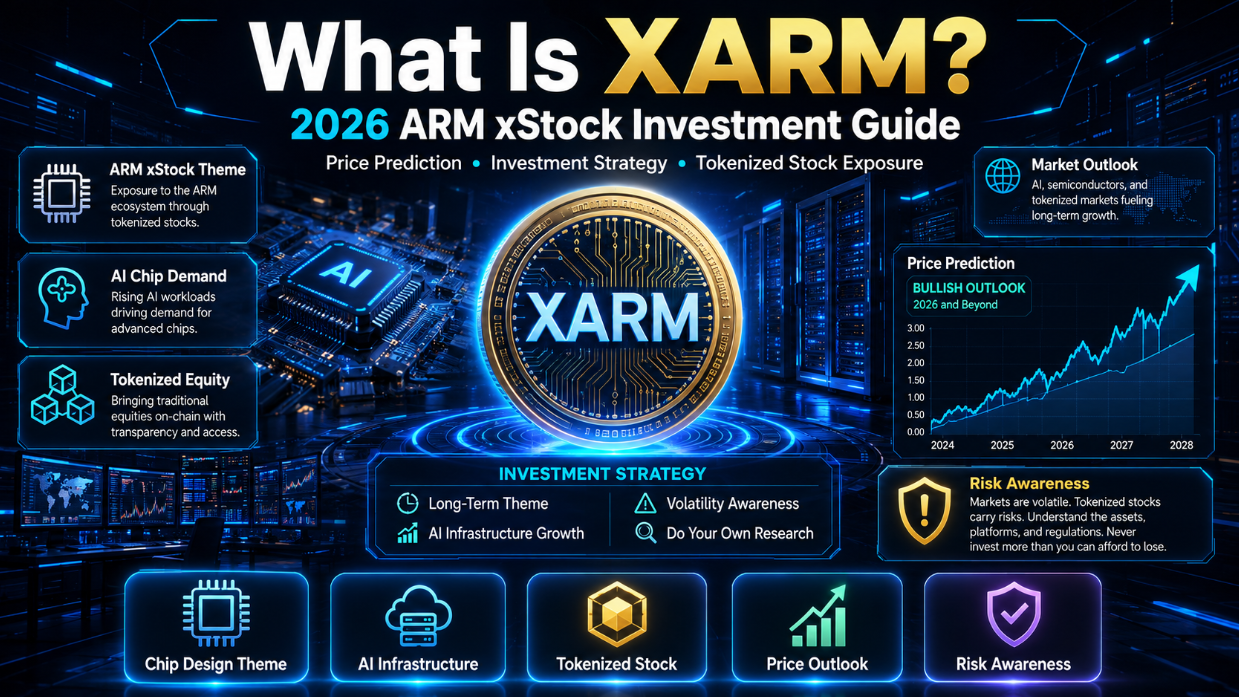
Arm Holdings trades on Nasdaq under the ticker ARM. XARM is designed for crypto and on-chain trading environments, giving users exposure to ARM-related economic performance using USDT.
Investors can check XARM real-time price and XARM/USDT market data to view the latest quotes, 24-hour change, volume, and price trends.
However, a market page only answers "what price XARM is trading at right now." It does not independently validate the issuance, custody, or redemption structure, nor does it guarantee that XARM will always track Nasdaq's ARM stock price perfectly at every moment.
Is XARM a Cryptocurrency Issued by Arm Holdings?
Do not interpret XARM as a corporate token that Arm Holdings created to build a blockchain ecosystem.
XARM is not a typical crypto project that derives value from:
- Token mining;
- Governance voting;
- Staking yields;
- Protocol fees;
- Token burns;
- Community memes;
- DeFi lockups;
- Token unlocks.
XARM's primary value logic comes from Arm Holdings' stock and its corporate fundamentals.
Therefore, when researching XARM, the focus should not be "what is this token used for." Instead, ask:
- How does Arm Holdings make money?
- What is ARM's architectural market position?
- Licensing revenue trends;
- Royalty revenue trends;
- Armv9 adoption rates;
- CSS business progress;
- ARM server penetration;
- AI and cloud capex;
- Company valuation;
- Whether XARM shows pricing deviations from ARM stock.
What Is the Relationship Between XARM and Nasdaq's ARM Stock?
ARM is the ticker for Arm Holdings on Nasdaq, representing the company's common stock in traditional securities markets.
XARM is a stock-linked tokenized asset designed to provide users with economic exposure tied to ARM stock price performance.
Under normal conditions, a rise in ARM stock may provide upward momentum for XARM, while a decline in ARM may pressure XARM.
But "price correlation" does not mean "identical legal structure."
Traditional stock investors typically hold shares through brokerage accounts and receive corresponding shareholder rights under securities regulations.
What rights XARM holders actually have depends on the xStock product terms, including:
- The ratio between tokens and underlying stock;
- Who holds the underlying ARM shares;
- Whether traditional voting rights are passed through;
- How dividends are handled;
- Whether minting or redemption is allowed;
- Whether retail users are eligible for redemption;
- What happens if the issuer faces issues;
- Whether underlying assets are segregated from issuer assets;
- Any regional restrictions.
So the more accurate understanding is:
Holding XARM primarily gives you economic exposure to Arm Holdings' stock performance, but it should not be directly equated with holding identical ARM common shares on Nasdaq's shareholder register.
Why Can ARM Stock Be Traded Using USDT?
The traditional path is typically:
Open a brokerage account, deposit fiat currency, and buy ARM shares on Nasdaq.
XARM offers an alternative path:
Users hold USDT and gain ARM-related price exposure through a platform that supports XARM/USDT.
This model may lower the friction for crypto users to switch between capital and trading environments, providing a more flexible entry point.
But trading with USDT does not mean the product is a regular cryptocurrency, nor does it imply lower risk than traditional stocks.
XARM investors face three layers of risk simultaneously:
Arm Holdings company risk + xStock issuance structure risk + Crypto trading environment risk.
2. What Is Arm Holdings, and Why Is It So Important If It Doesn't Manufacture Massive Quantities of Chips?
ARM is most often misunderstood as being similar to Intel, NVIDIA, or TSMC—companies that primarily make money by producing and selling vast numbers of physical chips.
In reality, ARM's core business is designing CPU architectures, processor cores, and computing IP, then licensing those technologies to other companies.
ARM Is Not a Traditional Chip Manufacturer
- TSMC's primary role is wafer fabrication—manufacturing chips for fabless design houses.
- NVIDIA primarily designs and sells GPUs, AI accelerators, networking products, and computing platforms.
- Intel and AMD offer CPUs and other processors.
ARM sits closer to the foundational layer of the computing industry—providing architecture and IP.
The basic business path:
ARM designs instruction sets, CPU cores, and related compute technologies, licenses IP to chip companies; customers design their own SoCs based on ARM technology; those chips are manufactured by foundries and go into phones, servers, cars, or other devices; ARM earns revenue from licensing and from royalties on chip shipments.
This model means ARM does not have to bear the capital expense and inventory risk of building wafer fabs, while still reaching diverse end markets through a broad ecosystem of partners.
But it also means ARM's revenue depends on customer adoption, chip design cycles, and end‑device shipments.
What Is a CPU Architecture?
A CPU architecture is the fundamental set of rules between software and processor hardware.
Operating systems, applications, compilers, and chip designs all must work within that architecture.
Key features of the ARM architecture include:
- High energy efficiency;
- Low power consumption;
- Flexible licensing;
- Suitability for SoC design;
- A large software ecosystem;
- Broad coverage of mobile and embedded devices.
Once an architecture accumulates a large base of hardware, software, developers, and devices, switching costs become very high. This is a critical moat for ARM.
How Does ARM Make Money?
ARM has two primary revenue streams.
Licensing Revenue
When companies obtain licenses for ARM architectures, CPU cores, or compute IP, they pay license fees under the agreements.
Licensing revenue can be influenced by new customers, new product designs, long-term contracts, and project timing, so it may fluctuate across quarters.
Licensing revenue reflects how many customers are adopting ARM technology to develop next-generation chips, but a license deal does not mean those chips have already entered mass production.
Royalty Revenue
After chips using ARM technology actually ship, customers may pay royalties to ARM under their contracts.
Royalty revenue is tied to chip shipment volumes, product types, the level of ARM technology used, and royalty rates.
This forms ARM's most important business logic:
ARM doesn't necessarily need to manufacture and sell its own chips to benefit; as the total volume of ARM‑based chips across the ecosystem grows, royalty revenue can rise across a broad industrial base.
If chip volumes grow simultaneously across mobile, servers, PCs, automotive, and IoT, royalty revenue can enjoy diversified support.
Why Is the Licensing‑Plus‑Royalty Model Attractive?
This model has several potential advantages:
- Lower capital expenditure compared to wafer fabrication;
- Ability to reach a wide range of chip customers;
- One architecture can enter multiple end markets;
- Growing chip shipments can generate ongoing royalties;
- Higher‑value products can increase revenue per chip;
- Software and hardware ecosystems create high switching costs.
But risks exist as well.
If customers adopt other architectures, chip shipments decline, or customer bargaining power increases, ARM's revenue will be affected.
3. Why Does ARM Almost Dominate Smartphones? How Solid Is XARM's Base?
Smartphones are ARM's most mature traditional market.
A vast number of mobile processors from Qualcomm, Apple, MediaTek, Samsung, and others are tied to the ARM instruction set or its technology ecosystem.
Why Do Phone Chips Overwhelmingly Use ARM Architecture?
Smartphones must handle heavy computing tasks within tight limits on battery, space, and heat dissipation.
ARM architecture has long emphasized performance‑per‑watt, making it ideal for mobile devices.
Its advantages include:
- Low power consumption;
- High energy efficiency;
- Flexible SoC design;
- Mature Android and iOS ecosystems;
- Extensive development tools;
- Broad support from chip vendors;
- Long‑standing application compatibility.
Phone makers and chip companies are not just buying a CPU core—they enter an ecosystem of software, compilers, operating systems, and developers that together form a powerful lock‑in.
This gives ARM a strong incumbency advantage in mobile.
What Is Apple's Relationship with ARM?
Apple's A‑series and M‑series chips are based on ARM instruction set technology, but Apple has strong in‑house design capabilities.
This shows that ARM's model does not require all customers to use identical processor cores. Some licensees can obtain more flexible architectural licenses and develop highly customized chips.
Apple's success also proves that ARM architecture is not just for phones—it can power high‑performance PCs and other compute devices.
Why Are Qualcomm, MediaTek, and Samsung Important?
Qualcomm's Snapdragon, MediaTek's Dimensity, and some of Samsung's Exynos products form the core chip platforms for the Android mobile ecosystem.
The shipments and new architecture adoption of these companies affect ARM's royalty revenue.
Investors need to track not just global smartphone sales, but also which generation of ARM technology is used in each chip and whether higher‑value architectures can lift average royalty per chip.
Why Is the Mobile Business Both a Strength and a Constraint?
The handset market provides ARM with a massive, mature, and relatively stable base.
But global smartphones have entered a mature phase, with volume growth unlikely to sustain early‑stage rapid expansion over the long term.
Therefore, XARM investors cannot rely solely on "ARM has a huge share in phones" to justify future valuations.
The market's real question has shifted to:
Can ARM replicate the energy efficiency, software, and ecosystem advantages it built in mobile into servers, PCs, automotive, and Edge AI?
The mobile business provides the base; new markets determine future growth elasticity.
4. Why Has the AI Era Re‑Rated ARM's Investment Value?
Many users assume the AI boom only benefits NVIDIA.
In reality, a large AI data center requires CPUs, GPUs, HBM, networking, storage, power, cooling, and software all working together.
One of ARM's major AI opportunities is entering server CPUs, custom chips, and Edge AI devices.
Why Do AI Data Centers Need More Than Just GPUs?
GPUs handle massively parallel compute, but AI servers still need CPUs for a wide range of general‑purpose tasks, including:
- Operating system management;
- Data preprocessing;
- Task scheduling;
- Network management;
- Storage control;
- Security management;
- General‑purpose computing;
- GPU coordination.
Thus, growth in AI server volumes typically increases demand for CPUs and other compute IP.
Why Is ARM Architecture Starting to Enter Data Centers?
Traditional server CPUs have long been dominated by the x86 architecture, primarily from Intel and AMD.
But cloud and AI data centers are increasingly focused on:
- Performance‑per‑watt;
- Total cost of ownership;
- Compute density;
- Electricity costs;
- Cooling efficiency;
- Customized compute;
- Workload optimization.
Large data centers run tens of thousands of servers or more. Even if a single server saves only a modest amount of power, scaling across the entire facility can yield significant cost differences.
ARM's long‑standing advantages in energy efficiency and flexible licensing thus become more compelling.
One sentence captures ARM's value shift across two eras:
In the mobile internet era, ARM helped devices extend battery life; in the AI data center era, ARM may help cloud providers improve compute density and power costs.
Why Does AI Data Center Power Matter?
AI servers consume significantly more power than general‑purpose servers, and data centers also bear cooling, power delivery, and network infrastructure costs.
When power supply and cooling become expansion bottlenecks, the amount of compute per watt directly impacts data center economics.
ARM won't automatically win the server market just because of high energy efficiency, but it offers cloud providers a design path that differs from traditional standardized CPUs.
5. Why Do Amazon, Microsoft, and Google Value ARM Servers?
Large cloud providers have enormous server procurement scales.
If they rely entirely on standardized CPUs over the long term, they bear the costs of supplier pricing, product roadmaps, and general‑purpose design compromises.
Thus, hyperscalers are increasingly willing to use ARM architecture to develop their own CPUs.
Why Do Cloud Providers Build Their Own Chips?
Large cloud providers want to:
- Optimize for their own workloads;
- Reduce procurement costs;
- Improve performance‑per‑watt;
- Reduce dependency on a single vendor;
- Enhance software‑hardware co‑design;
- Offer differentiated cloud services;
- Control product roadmaps and supply cadence.
ARM's licensing model allows customers to develop custom CPUs and SoCs based on ARM architecture, which aligns perfectly with hyperscaler needs.
What Does AWS Graviton Mean?
Amazon proved, through its Graviton server CPUs, that ARM architecture can run cloud computing workloads at scale.
The significance of Graviton is not just that Amazon bought ARM‑related chips—it provided a commercial proof point for the entire server market:
ARM is not only for phones and embedded devices; it can handle real production workloads in large cloud data centers.
If customers choose Graviton instances for price, energy efficiency, or performance, Amazon may continue expanding its deployment, and ARM could benefit from server chip shipments.
What Does Microsoft and Google Entering ARM Servers Mean?
If Microsoft, Google, and more cloud providers adopt or develop ARM server CPUs, ARM's addressable market expands from mobile devices to cloud and AI data centers.
This brings two layers of value.
First, increased server chip volumes.
Second, server‑class products typically carry higher value, corresponding to higher licensing and royalty rates.
However, self‑developed chips are a double‑edged sword.
Large customers have strong design capabilities and bargaining power. If they use only the ARM instruction set and reduce reliance on more complete ARM cores and CSS products, ARM's economic value per chip may be squeezed.
So investors should not just look at "customer adopts ARM" but also study which layer of ARM technology the customer is using.
6. What Is the Relationship Between ARM and NVIDIA? Why Is XARM Also Part of the AI Chip Value Chain?
ARM is not a simple competitor to NVIDIA.
In many AI servers, CPUs and GPUs perform different roles, forming a collaborative relationship.
GPUs primarily handle AI training, inference, and parallel compute, while CPUs handle general‑purpose computing, system management, data preparation, and task scheduling.
A complete server may consist of:
- CPUs;
- GPUs;
- HBM;
- Networking equipment;
- Optical interconnects;
- Storage;
- Power and cooling.
Is ARM a Competitor to NVIDIA?
ARM primarily provides compute architectures and IP; NVIDIA sells GPUs, AI platforms, networking products, and related systems.
In some areas they may have potential competition or bargaining dynamics, but in AI servers they can also be complementary.
NVIDIA can develop CPUs using ARM architecture, while ARM can tap into more server scenarios through NVIDIA's AI platforms.
Why Is NVIDIA Grace Worth Watching?
NVIDIA's Grace CPU is based on ARM architecture and targets data centers and high‑performance computing.
Grace shows that ARM is already participating in core AI server compute platforms, not just peripheral control devices.
If NVIDIA Grace and related superchip platforms gain broader adoption, the market may further raise its attention to ARM's data center architecture.
But NVIDIA's AI business growth does not automatically translate into ARM revenue at a fixed ratio.
Investors should also track:
- Actual Grace shipments;
- Customer adoption;
- The level of ARM licensing used;
- Royalty per chip;
- Product lifecycles;
- NVIDIA's future technology roadmap.
Who Benefits More Directly from AI—ARM or NVIDIA?
NVIDIA sells GPUs, accelerators, and AI compute platforms directly, so its revenue elasticity to AI capex is typically more immediate.
ARM benefits indirectly through CPU architecture, IP licensing, and royalties. Its reach may be broader, but revenue per chip and timing depend on contracts and product shipments.
Thus, XARM and NVIDIA stock are not identical AI investment vehicles.
7. Why Are Armv9 and CSS Important? How Does ARM Increase Revenue Per Chip?
ARM's future revenue growth does not depend solely on the number of chips.
Another critical variable is: how much revenue can each ARM‑based chip contribute?
What Problem Does the Traditional Licensing Model Face?
If customers only take a basic architecture or core license, ARM's economic value per chip may be limited.
As customers' chip design capabilities grow, ARM needs to offer higher‑performance, more secure, and more complete technologies to maintain bargaining power and improve royalty yields.
Why Is Armv9 Important?
Armv9 is ARM's next‑generation architecture, targeting:
- Improved performance;
- Enhanced security features;
- Better AI and machine learning capabilities;
- Support for more complex computing;
- Entry into higher‑value end devices;
- Higher royalty rates on related products.
Investors should not just count how many ARM chips ship—they should also watch the adoption rate of Armv9 in phones, servers, PCs, and automotive.
If total chip volume growth is limited but the share of high‑value Armv9 products rises, ARM's revenue can still grow.
What Is CSS?
CSS stands for Compute Subsystems.
In the traditional model, ARM might provide CPU cores or basic IP, and customers would handle more system integration and design work themselves.
CSS offers customers a more complete, validated compute subsystem, enabling them to shorten development time and reduce some design complexity.
For customers, CSS may mean:
- Faster time‑to‑market;
- Lower design risk;
- Less redundant development;
- More mature performance and power profiles.
For ARM, CSS may mean:
- Offering higher‑value products;
- Deepening customer dependency;
- Increasing licensing revenue;
- Raising per‑chip royalties;
- Expanding economic value in servers and high‑end chips.
Thus, ARM's potential growth formula is not just chip count growth, but:
ARM chip volume growth × higher adoption of high‑value architectures × higher per‑chip royalty.
Is CSS Risk‑Free?
No.
Some large customers have strong in‑house design capabilities and may not want to use overly complete subsystems.
If CSS raises costs or limits customization, some chip companies might choose more basic licensing models or even explore alternatives like RISC‑V.
So whether CSS can boost revenue depends on actual customer adoption, not just ARM's product announcements.
8. Can ARM Challenge Intel and AMD?
The server CPU market has long been dominated by the x86 architecture, with Intel and AMD offering mature products, software compatibility, enterprise customer relationships, and a data center ecosystem.
ARM is expanding its server presence, but it would be oversimplified to write "ARM will replace x86."
Why Has x86 Dominated Servers for So Long?
Key reasons include:
- A massive software ecosystem;
- Enterprise application compatibility;
- Long‑standing data center deployments;
- Mature development tools;
- Intel and AMD's product capabilities;
- IT teams' operational experience;
- Server vendor support;
- High migration costs.
For enterprises, switching CPU architecture is not just swapping hardware—it also involves application adaptation, testing, operations, and security validation.
Does ARM Need to Fully Replace x86?
No.
The server market is enormous. Even if ARM only increases its share from a low base to a moderately higher percentage, that could generate significant incremental licensing and royalty revenue for ARM.
So XARM investors should focus on:
- ARM server CPU shipments;
- Cloud providers' ARM instance counts;
- Customer utilization rates;
- Server software support;
- Data center workload migration;
- Server chip royalties;
- Hyperscaler custom CPU plans.
A more reasonable question is not "will ARM completely beat Intel?" but:
Can ARM continue to gain server market share over time?
How Will Intel and AMD Respond?
Intel and AMD are also improving CPU performance, efficiency, and AI capabilities, and they continue to enhance their data center platforms.
The x86 ecosystem will not vanish automatically because of ARM's growth.
If Intel and AMD remain competitive on performance, efficiency, pricing, and software support, ARM's server penetration may be slower than market expectations.
9. Beyond AI Servers, What Other Growth Curves Does ARM Have?
Interpreting XARM purely as an AI server asset would ignore ARM's much broader end‑device ecosystem.
ARM Windows PCs
Apple's M‑series chips have already proven that ARM can deliver high performance, low power, and long battery life in PCs.
Windows on ARM is also expanding its footprint.
Investors can watch:
- ARM PC chips from Qualcomm and others;
- Windows application compatibility;
- AI PC demand;
- OEM adoption;
- Performance‑per‑watt;
- Consumer acceptance;
- Enterprise deployments.
If ARM gains share in PCs, it opens another large end‑market beyond phones.
But software compatibility, gaming, peripheral drivers, and the x86 ecosystem remain major challenges.
Automotive Chips
Cars are incorporating more compute functions, including:
- ADAS;
- Smart cockpits;
- MCUs;
- In‑vehicle infotainment;
- Automotive operating systems;
- Autonomous driving compute;
- Body control;
- Network connectivity.
A single smart vehicle may use multiple processors and control chips.
ARM's strengths in low‑power, embedded, and SoC designs position it to benefit from automotive electrification and intelligence.
Automotive chip qualification cycles are long, but product lifecycles can also be longer.
Edge AI
AI will not run only in the cloud.
More and more AI tasks will be executed locally on devices such as:
- Phones;
- PCs;
- Cars;
- Cameras;
- Robots;
- IoT devices;
- Wearables;
- Industrial equipment.
Running AI locally reduces latency, cuts data transmission, and improves privacy and offline capability.
ARM's massive installed base across end‑devices gives it a natural entry point for Edge AI.
However, whether Edge AI boosts ARM revenue depends on whether end‑chips adopt higher‑value architectures and whether customers are willing to pay higher royalties.
10. What Actually Determines XARM's Price?
XARM's price is affected by at least five layers of factors.
ARM Stock Price on Nasdaq
Nasdaq's ARM stock is XARM's most fundamental price anchor.
When ARM stock rises, XARM typically gets upward momentum; when ARM falls, XARM usually faces pressure.
But when comparing the two, you need to confirm:
- The unit ratio between XARM and ARM;
- Whether U.S. markets are open;
- The timing of the latest quotes;
- Exchange rates and fees;
- Dividend treatment;
- Bid‑ask spreads;
- Whether a premium or discount exists.
Arm Holdings Earnings Reports
Investors should focus on:
- Revenue;
- Licensing revenue;
- Royalty revenue;
- EPS;
- Gross margin;
- Operating income;
- Cash flow;
- Guidance.
Among these, royalty revenue helps gauge actual chip shipments and high‑value architecture contributions.
Licensing revenue more reflects new customers, new chip designs, and long‑term partnerships.
AI and Data Center Growth
Important metrics that affect ARM's server narrative include:
- AI server shipments;
- Hyperscaler capex;
- ARM server penetration;
- AWS Graviton usage;
- NVIDIA Grace ecosystem;
- Data center CPU demand;
- Cloud workload migration.
ARM Stock Valuation
This may be the most overlooked risk for XARM.
A great company does not mean any price is worth paying.
If the market has already priced in years of AI, server, PC, and automotive growth ahead of time, the stock may still correct on valuation compression even as revenues continue to rise.
Investors need to distinguish between:
- Upside driven by earnings growth;
- Upside driven by P/E or valuation multiple expansion.
If the stock is moving mostly on multiple expansion while earnings estimates haven't been revised up in tandem, the risk of chasing becomes materially higher.
XARM's Own Liquidity
XARM is also affected by the crypto trading environment, including:
- USDT trading depth;
- Bid‑ask spreads;
- On‑chain liquidity;
- Market maker quotes;
- Time differences with U.S. markets;
- Solana network status;
- Platform deposits and withdrawals;
- Short‑term speculative sentiment.
Therefore, XARM and ARM stock may experience pricing deviations in the short term.
11. What Are the Differences Between XARM and Buying ARM Stock Directly?
Different Trading Venues
ARM trades on the traditional Nasdaq securities market.
XARM trades on crypto platforms or related on‑chain environments.
Different Settlement Assets
XARM/USDT uses USDT as the quote and settlement asset.
USDT targets a stable value against the dollar, but it is not bank USD in a brokerage account. Investors also need to consider stablecoin and platform risks.
Different Trading Hours
Nasdaq has set trading sessions, with some brokers offering pre‑market and after‑hours trading.
XARM may offer longer trading windows, but extended hours do not guarantee sufficient liquidity at all times.
When U.S. markets are closed, XARM may price in company news, AI sector moves, and crypto order flow ahead of the open, which can also lead to larger deviations.
Different Shareholder Rights
Gaining price exposure to ARM stock does not necessarily mean you become a registered shareholder of Arm Holdings.
Check the XARM product terms for:
- Voting rights;
- Dividend treatment;
- Corporate actions;
- Redemption rights;
- Custody structure;
- Underlying ownership;
- Bankruptcy arrangements.
Additional Issuance and On‑Chain Risks
XARM investors also face:
- Issuer risk;
- Custody risk;
- Asset segregation risk;
- Smart contract risk;
- Solana network risk;
- Platform risk;
- Liquidity risk;
- Premiums and discounts;
- Regional regulatory risk.
12. Why Does XARM Deserve Attention? Four Investment Theses for 2026
Mobile Ecosystem Provides a Base
ARM has a massive installed base in phones and embedded devices.
Even though the smartphone market is mature, the sheer volume of ongoing shipments still provides a royalty foundation for ARM.
AI Drives Server Adoption of ARM
AI data centers are increasingly focused on performance‑per‑watt, compute density, and custom silicon.
This creates an opportunity for ARM architecture to enter the server market.
If AWS, Microsoft, Google, NVIDIA, and others expand ARM server platforms, ARM could see higher‑value licensing and royalty revenue.
Edge AI Raises the Value of End‑Devices
AI is moving from the cloud into phones, PCs, cars, and IoT devices.
ARM covers a vast range of end‑compute platforms, positioning it to participate in Edge AI hardware upgrades.
Higher‑Value Architectures May Boost Per‑Chip Revenue
ARM's growth is not just about more chips—it can also come from Armv9 and CSS raising per‑chip revenue.
The real growth formula to watch is:
More ARM chips × higher value‑product mix × higher per‑chip royalty.
13. What Are the Biggest Risks of XARM?
ARM Valuation Risk
The higher the expectations for AI, servers, and Edge AI, the more those expectations may already be priced in.
Even if the company continues to grow, if it falls short of excessively high expectations, both the stock and XARM can fall.
Customer Self‑Development and Bargaining Power
Large chipmakers and cloud providers have strong in‑house design capabilities.
They may only take a basic ARM architecture license and do much of the CPU and system design themselves, thereby compressing ARM's economic value per chip.
RISC‑V Competition
RISC‑V is an open instruction set architecture that allows companies to design processors on a more open basis.
It appeals to chipmakers because it offers:
- Reduced licensing dependency;
- Greater customization freedom;
- An independent technology roadmap;
- Avoidance of single‑vendor lock‑in;
- Suitability for certain embedded and custom scenarios.
RISC‑V may not fully displace ARM's massive mobile and software ecosystem in the short term, but it could gain ground first in:
- MCUs;
- IoT;
- Embedded devices;
- Control chips;
- Specialized accelerators;
- Certain automotive and industrial chips.
If RISC‑V gradually moves into higher‑performance segments, ARM's licensing model could face greater pressure.
x86 Competition
Intel and AMD have mature server products and large software ecosystems.
If x86 continues to improve energy efficiency and maintain enterprise compatibility advantages, ARM server growth may be slower than expected.
AI Capex Slowdown
If Amazon, Microsoft, Google, Meta, and others reduce AI and data center investment, valuations across server‑related assets could retreat.
SoftBank Shareholding and Capital Structure Risks
Arm Holdings' ownership concentration, major shareholder changes, and potential share sales can also affect market supply and investor sentiment.
Beyond business growth, investors should also monitor the company's equity structure and public float.
XARM Structural Risks
XARM also has:
- Tracking error vs. underlying stock;
- Issuer and custodian risks;
- Smart contract risks;
- Solana network risks;
- Platform liquidity;
- Premiums and discounts;
- Regional restrictions;
- Regulatory changes.
14. XARM Investment Strategy: Fundamental Trends Approach
A medium‑term investor can check four conditions simultaneously.
First, Arm Holdings' total revenue continues to grow.
Second, royalty revenue remains strong, indicating that ecosystem chip shipments and high‑value architecture contributions have not materially weakened.
Third, ARM server penetration continues to increase.
Fourth, management guidance has not been materially lowered.
If all four trends still hold, XARM's medium‑term fundamental thesis has not clearly broken.
But fundamental growth does not automatically mean the current price is reasonable. Investors also need to judge whether growth has already been priced in by valuation.
15. XARM Investment Strategy: Earnings Confirmation Approach
Investors who wish to avoid earnings gap risk can wait until Arm Holdings reports results before reassessing.
Key checks:
- Did revenue beat market expectations?
- Did royalty revenue grow?
- Did licensing revenue reflect new designs and new customers?
- Armv9 and CSS adoption updates;
- Data center business progress;
- EPS and margins;
- Management guidance.
Stocks trade on the future, not just the past.
So it's possible that:
- Revenue beats, but guidance is lowered, and the stock drops;
- Current profits are mediocre, but server adoption exceeds expectations, and the stock rises;
- Revenue grows, but valuation is already too high, and the stock corrects after good news.
The earnings confirmation approach may miss some post‑earnings gains, but it can reduce the risk of guessing earnings outcomes blindly.
16. XARM Investment Strategy: AI Capex Linkage Approach
ARM's server growth environment can be observed through hyperscaler capex.
Key names to watch:
- Amazon;
- Microsoft;
- Google;
- Meta;
- NVIDIA.
The full logic:
Hyperscalers increase AI capex, driving AI server and data center construction; data centers need more CPUs, GPUs, networking, and storage; cloud providers expand custom ARM server chips; ARM architecture and royalty revenue may benefit.
But capex growth must be paired with actual ARM server adoption.
If AI investment flows mainly into GPUs and other equipment while ARM server CPU penetration does not improve, the direct benefit to ARM may be lower than market expectations.
17. XARM Investment Strategy: Valuation and Scaling‑In on Pullbacks
ARM is a high‑quality company, but that doesn't mean every price is a good entry.
After a rapid price rise, run three checks.
Has the Fundamental Story Changed?
If revenue, royalties, server penetration, and guidance continue to improve, the long‑term thesis may still be valid.
Is the Upside Driven by Earnings Upgrades or Multiple Expansion?
If earnings estimates are rising in tandem, the price move has more fundamental support.
If earnings estimates have barely moved but P/E or valuation multiples are surging, the risk of chasing increases.
Has a Reasonable Pullback Occurred?
Newly listed XARM may also experience larger volatility due to liquidity and price discovery.
Investors may scale into positions in tranches according to their own plans, rather than committing all capital at once.
For example, a plan to commit 1,000 USDT could be split into four parts for an observation position, trend confirmation, earnings validation, and reserve capital.
This is only a position‑sizing illustration, not a fixed rule suitable for everyone.
Tranching does not replace stop‑loss discipline. If fundamentals deteriorate, mechanical averaging can enlarge losses.
18. When Should You Consider Reducing XARM Exposure?
Exit decisions are best based on changes in the investment thesis, not random daily fluctuations.
Watch for these signals:
- ARM server penetration significantly below expectations;
- Royalty revenue consistently slowing;
- Armv9 or CSS adoption below expectations;
- Major cloud providers cutting AI capex;
- RISC‑V gaining breakthroughs in key markets;
- Management consistently lowering guidance;
- Stock price rising rapidly but earnings estimates not keeping up;
- XARM showing a persistent and significant premium;
- Token market depth declining markedly.
If multiple signals appear simultaneously, XARM's fundamentals, valuation, or trading structure may be changing.
19. XARM Price Prediction: Three Scenarios Instead of a Fixed Target
Investors can refer to XARM price forecast and market trends to observe trend changes across different periods.
But XARM price predictions should not be reduced to a single target number.
Optimistic Scenario
The optimistic scenario requires all of the following:
- Continued AI capex growth;
- Rising ARM server penetration;
- Expansion of Graviton, Grace, and other ARM server platforms;
- Increasing Armv9 and CSS adoption;
- Growth in per‑chip royalty;
- Expansion in ARM PCs, automotive, and Edge AI;
- Consistently upgraded company guidance;
- Current valuation not severely overstretched;
- XARM maintaining ample liquidity.
In this case, Arm Holdings earnings expectations may continue to be revised upward, and XARM could benefit from underlying stock appreciation.
Neutral Scenario
A neutral scenario might include:
- Continued AI industry growth;
- Slow but steady ARM server share gains;
- Mobile base remaining stable;
- PC and automotive businesses developing gradually;
- Normal revenue growth;
- But current valuation already elevated.
In this case, XARM's price may rely more on actual earnings growth rather than rapid multiple expansion.
Pessimistic Scenario
A pessimistic scenario might include:
- AI capex slowing;
- ARM server adoption below expectations;
- Increasing RISC‑V competition;
- x86 improving efficiency and competitiveness;
- Weak smartphone chip shipments;
- Insufficient Armv9 or CSS adoption;
- Declining royalty revenue;
- Valuation contraction;
- Deteriorating XARM liquidity.
If both company fundamentals and the token trading structure weaken simultaneously, XARM could see a significant drawdown.
20. How Do XARM, BTC, and ETH Relate?
XARM, BTC, and ETH can all be accessed in crypto trading environments, but their value sources differ.
XARM's core value comes from Arm Holdings' corporate fundamentals.
BTC is primarily influenced by the Bitcoin network, fixed supply, market demand, macro liquidity, and portfolio allocation trends.
ETH is tied to the Ethereum network, gas fees, staking, smart contracts, and on‑chain ecosystem activity.
Investors can combine insights from BTC price predictions and market cycles to gauge whether crypto markets are in risk‑on or risk‑off mode.
They may also reference ETH price predictions and Ethereum trends to monitor on‑chain finance and tokenized asset market activity.
BTC and ETH can influence:
- Overall crypto risk appetite;
- USDT trading activity;
- XARM order book depth;
- Token premiums and discounts;
- Platform volumes;
- Short‑term deleveraging.
But they are generally not the determining factors for ARM's long‑term value.
The medium‑ and long‑term direction of XARM is still driven by:
- ARM revenue;
- Royalties;
- Server penetration;
- Armv9 and CSS;
- AI capex;
- Company valuation.
21. How to View and Trade XARM on HiBT
View XARM Live Prices
Investors can check XARM real‑time price, change, and market data to see the latest quotes, volume, and historical trends.
Prepare USDT
Users can obtain USDT through supported platform methods, or deposit from other wallets and platforms.
Before depositing, verify:
- The deposit network;
- The deposit address;
- Minimum amount;
- Whether the network is active;
- Whether a memo or tag is required.
Search for XARM/USDT
Go to the platform's trading section and search for XARM or XARM/USDT.
XARM and ARMB are different tickers; do not ignore product and network differences just because they reference the same underlying company.
Check Four Things Before Placing an Order
First, the current ARM stock price and trend.
Second, whether there is any Arm Holdings earnings, product, or industry news that day.
Third, XARM/USDT volume and order book depth.
Fourth, the bid‑ask spread and whether XARM's price relative to ARM reference value appears normal.
Use Limit or Market Orders
Limit orders allow you to set a price but do not guarantee execution.
Market orders execute quickly, but for newly listed assets or thin liquidity, they may incur significant slippage.
During XARM's price discovery phase after listing, market order risks need extra caution.
22. What Is the Difference Between XARM and SPYON?
What is SPYON USDT introduces a tokenized asset tied to an S&P 500 ETF.
XARM focuses on a single company—Arm Holdings—with investment themes including:
- Semiconductor IP;
- AI chip architecture;
- Servers;
- Cloud computing;
- PCs;
- Automotive;
- Edge AI.
SPYON provides broader exposure to a basket of large U.S. companies, with much more sector and name diversification.
XARM is characterized by high concentration, greater company‑specific growth potential, but also higher idiosyncratic and valuation volatility.
SPYON offers more diversification but is still affected by U.S. equity markets, macroeconomic factors, ETF valuations, and tokenized asset structure.
23. What Is the Difference Between XARM and SOXLON?
What is SOXLON USDT corresponds to a leveraged ETF product for the semiconductor sector.
XARM is a bet on a single company—Arm Holdings—its technology, licensing model, royalty revenue, and market share.
SOXLON leans more toward a leveraged exposure to the entire semiconductor industry, potentially covering GPUs, CPUs, wafer foundries, chip equipment, and other semiconductor names.
SOXLON may also involve daily reset leverage, volatility drag, and path‑dependency.
Thus:
Being bullish on Arm Holdings as a company is a different investment judgment from being bullish on the entire semiconductor industry.
24. What Is the Difference Between XARM and CBRSON?
What is CBRSON USDT explains the logic of tokenized assets linked to consumer retail names like Carrefour.
XARM is a tech‑growth asset, with primary drivers including:
- AI;
- Semiconductors;
- Servers;
- Cloud computing;
- Chip architecture;
- Royalty growth.
CBRSON is more consumer‑retail oriented, influenced by:
- Consumer demand;
- Food retail;
- Store operations;
- European economy;
- Margins;
- Defensive demand.
Both may be traded as tokens on crypto platforms, but the underlying companies, industry cycles, and valuation methodologies are entirely different.
Tokenized stock is just the trading vehicle; the real value driver is the underlying company and its assets.
25. XARM FAQs
What Is XARM?
XARM is an ARM xStock product linked to Arm Holdings plc, providing users with economic exposure tied to the Nasdaq ARM stock price.
What Coin Is XARM?
XARM exists in token form, but it is not a typical crypto project coin. Its primary value comes from Arm Holdings' corporate fundamentals and stock performance.
Is XARM a Stock or a Cryptocurrency?
XARM uses blockchain and crypto trading infrastructure, but its underlying value points to a traditional stock. It is better understood as a stock‑linked tokenized asset.
What Is the Difference Between XARM and ARM Stock?
ARM trades on Nasdaq in traditional securities markets, while XARM trades in crypto environments using USDT. They differ in trading venues, holder rights, custody, trading hours, and additional risks.
Does Buying XARM Equal Buying ARM Stock Directly?
Not exactly. XARM primarily offers economic exposure to ARM stock, but whether it conveys traditional voting rights, dividend entitlements, and direct shareholder status depends on the product terms.
What Is the Difference Between XARM and ARMB?
ARMB is an earlier Arm Tokenized bStock that runs on BSC. XARM is the ARM xStock, which according to HiBT's announcement runs on Solana. Both have the same underlying Arm Holdings exposure, but the issuance products, networks, contract addresses, and trading codes differ and should not be confused.
Why Is ARM Related to AI?
AI data centers need not only GPUs but also CPUs for general‑purpose computing, system management, and task scheduling. ARM's energy efficiency and customizability are driving its entry into more server and AI compute platforms.
What Is the Relationship Between ARM and NVIDIA?
ARM provides CPU architectures and related IP; NVIDIA primarily offers GPUs, AI platforms, and networking products. NVIDIA's Grace CPU is based on ARM, showing that the two can be complementary in AI servers.
Will ARM Replace Intel and AMD?
Not directly. x86 has a mature server software and enterprise ecosystem. Even a modest increase in ARM's server share could generate significant growth without requiring a full replacement of x86.
Why Is XARM Rising?
Possible reasons include ARM stock appreciation, earnings beats, royalty revenue growth, rising ARM server penetration, increased AI capex, Armv9 and CSS adoption, as well as XARM's own liquidity or premium/discount dynamics.
Is XARM Worth Investing In?
Investors should assess ARM revenue, royalties, server business, AI capex, RISC‑V and x86 competition, company valuation, and XARM's issuance and liquidity risks.
Is XARM Suitable for Long‑Term Investment?
The long‑term thesis depends on whether ARM can expand from phones into servers, PCs, automotive, and Edge AI, while raising per‑chip revenue via Armv9 and CSS. Investors should also evaluate whether current valuation has already priced in growth.
Does XARM Price Track ARM Stock Exactly?
Not necessarily. The two are theoretically highly correlated, but deviations may occur due to trading hours, market depth, unit conversions, fees, and premiums or discounts.
What Is the XARM Price Prediction?
A fixed target price has limited reliability. A more reasonable approach is to build scenarios based on AI capex, ARM server penetration, royalty revenue, company valuation, and XARM liquidity. Investors can also refer to the latest XARM price forecast.
What Are the Biggest Risks of XARM?
Key risks include overvaluation of ARM, slower‑than‑expected server adoption, RISC‑V and x86 competition, customer bargaining power, AI capex slowdown, as well as XARM's issuance, custody, Solana network, liquidity, and regulatory risks.
26. Summary: What Four Things Should You Judge When Investing in XARM?
XARM is not a typical crypto project that requires deep study of tokenomics, burn mechanisms, or community memes.
Its long‑term value is rooted in whether Arm Holdings can extend the architecture and ecosystem advantages built in the mobile era into AI servers, PCs, automotive, and Edge AI.
The full investment logic flows as follows:
AI compute demand continues to grow; data centers need more energy‑efficient CPUs and custom silicon; Amazon, Microsoft, Google, NVIDIA, and others expand ARM server platforms; ARM server penetration rises, generating more licensing and royalties; Armv9 and CSS raise the value mix and per‑chip economics; PCs, automotive, and Edge AI offer new growth curves; Arm Holdings' revenue, profit, and cash flow improve; the market re‑rates ARM stock based on future earnings; the underlying stock and xStock pricing mechanisms ultimately affect XARM's price.
But this logic needs to be verified layer by layer.
Investors should answer four questions in order:
First, is AI compute and cloud data center demand still growing?
Second, can ARM successfully expand from phones into servers, PCs, automotive, and Edge AI?
Third, can Arm Holdings increase per‑chip revenue through Armv9, CSS, and higher‑value licensing?
Fourth, have current ARM and XARM prices already priced in this growth?
If the first three fundamental directions remain positive and the fourth—valuation—is not significantly overstretched, then XARM's medium‑ and long‑term investment thesis is more worthy of continued research.
If server ARM‑ization falls short of expectations, RISC‑V competition intensifies, royalty revenue slows, or valuation outruns earnings growth too quickly, even a still‑important company like ARM could see XARM decline materially.
Therefore, analyzing XARM is best approached with:
ARM company fundamentals + AI compute demand + architecture licensing and royalties + xStock pricing mechanism.
Tokenized stock is just XARM's trading form; whether Arm Holdings becomes a key beneficiary of CPU architecture in the AI era is the core question that determines its long‑term value.