
The digital landscape is shifting beneath our feet. We are transitioning from the age of social connection to an era of digital ownership. You have likely heard the buzzwords: blockchain, decentralized finance, NFTs, and the metaverse. But what ties them all together? The answer is Web3. If you are asking yourself, "What is Web3 all about?", you are not alone. This is not just a technological upgrade; it is a fundamental reimagining of how the internet works, who owns it, and how value is created and shared.
For the vibrant and rapidly growing digital economy in Vietnam, understanding Web3 is no longer optional—it is essential. From Hanoi to Ho Chi Minh City, traders, developers, and investors are waking up to the potential of a decentralized internet. Whether you are a complete novice looking to buy your first fraction of Bitcoin or a seasoned expert navigating complex DeFi protocols, this guide serves as your roadmap. We will strip away the jargon, explore real-world applications, and provide actionable strategies for navigating this brave new world safely and profitably.
The Evolution of the Web: How Did We Get Here?
To truly grasp what Web3 is, we must first look at where we have been. The history of the internet is a story of evolution, moving through distinct phases that have defined our digital lives.
Web1: The Read-Only Web (1990–2004)
Imagine the internet as a massive digital library. In the early days, Web1 was static. It was a "read-only" experience. Users could log on, browse information, and consume content, but that was about it. Websites were built on simple protocols like HTML, and content was created by a tiny fraction of users—mostly developers and businesses. There were no "like" buttons, no comment sections, and certainly no social media feeds. It was decentralized in infrastructure but centralized in content creation.
Web2: The Read-Write Web (2004–Present)
Then came the revolution of interactivity. Web2, the "social web," transformed users from passive observers into active participants. We started blogging, sharing photos, uploading videos, and connecting on platforms like Facebook, YouTube, and Twitter. This era unlocked immense creativity and connectivity.
However, this convenience came with a hidden cost. To use these free services, we traded our data. The infrastructure of Web2 became highly centralized. A handful of massive technology corporations now control the servers, the data, and the rules of engagement. They monetize your attention and your information. You create the content, but they own the platform—and often, the value generated from your work.
Web3: The Read-Write-Own Web (The Future)
This brings us to the present moment. Web3 is the "read-write-own" web. It keeps the interactivity of Web2 but fundamentally changes the power dynamic by introducing ownership.
In Web3, users own their data, their identity, and their digital assets. This is made possible by blockchain technology. Instead of trusting a tech giant to hold your data on their private servers, your assets exist on a decentralized ledger that no single entity controls. When you play a game in Web3, you own the in-game items. When you post on a decentralized social network, you own the content. When you contribute to a network, you earn a share of the value in the form of tokens.
The Core Pillars of Web3 Technology
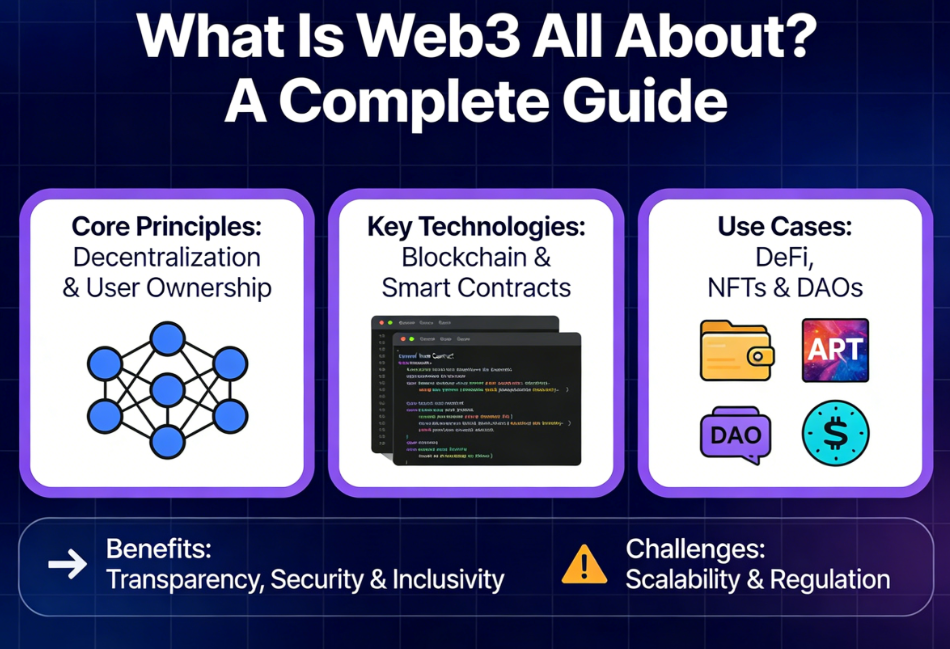
Web3 is not a single technology but a stack of protocols and concepts working in harmony. Let's break down the pillars that hold this new internet together.
1. Blockchain and Decentralization
At the heart of Web3 lies the blockchain. A blockchain is a shared, immutable ledger that records transactions across a network of computers. Because the ledger is distributed, no single person or company can alter the data or shut down the network. This is what we mean by "decentralization."
In Vietnam, where digital adoption is skyrocketing, the appeal of a trustless system is strong. You don't need to trust a bank or a corporation to verify a transaction; you trust the code. This transparency reduces corruption, lowers costs by removing middlemen, and increases security.
2. Smart Contracts
If blockchain is the database, smart contracts are the software running on top of it. A smart contract is a self-executing contract with the terms of the agreement directly written into lines of code.
Think of a vending machine. You put in money, select a product, and the machine automatically delivers it. No shopkeeper is needed. Smart contracts work the same way but for complex digital agreements. They can automatically execute loans, transfer ownership of art, or distribute funds without human intervention. This automation is the backbone of Decentralized Finance (DeFi) and allows for efficiency that traditional systems cannot match.
3. Digital Assets and Tokenization
Web3 introduces the concept of tokenization—representing ownership of real or digital assets as tokens on a blockchain.
- Cryptocurrencies: Native tokens like Bitcoin (BTC) or Ethereum (ETH) serve as digital money and store of value.
- Utility Tokens: These provide access to specific services or products within a Web3 ecosystem.
- Governance Tokens: These give holders the right to vote on decisions influencing the future of a protocol.
- NFTs (Non-Fungible Tokens): These represent ownership of unique items, from digital art to real estate deeds.
Platforms like HIBT are pivotal in this ecosystem, providing the infrastructure for users to trade, hold, and manage these diverse digital assets securely. They act as the bridge between the traditional economy and the tokenized future.
Web3 for Beginners in Vietnam: A Practical Start
Entering the world of Web3 can feel overwhelming. The terminology is dense, and the technology moves fast. However, for the Vietnamese market, the barrier to entry has never been lower. Here is a step-by-step guide to getting started.
Step 1: Establishing Your Digital Identity (The Wallet)
In Web3, your "username and password" is your crypto wallet. This digital tool stores your private keys—the cryptographic proof that you own your assets.
There are two main types of wallets you should know about:
- Hot Wallets: These are software applications connected to the internet (like mobile apps or browser extensions). They are convenient for daily use and interacting with applications.
- Cold Wallets: These are physical hardware devices that keep your keys offline. They offer the highest security and are recommended for storing significant savings.
Action Item: Download a reputable hot wallet today. Write down your "seed phrase" (a list of 12-24 words) on paper and store it safely. Never share this phrase with anyone.
Step 2: Acquiring Your First Digital Assets
To interact with Web3 applications, you typically need cryptocurrency to pay for transaction fees (often called "gas"). This usually means acquiring some Ethereum (ETH), Solana (SOL), or stablecoins like USDT.
For users in Vietnam, the most straightforward path is to use a centralized exchange. These platforms allow you to exchange local currency for crypto. When choosing an exchange, prioritize security, liquidity, and user support. HIBT offers a user-friendly interface tailored for both beginners and pros, ensuring that your first step into the crypto world is smooth and secure.
Step 3: Exploring Decentralized Applications (dApps)
Once you have a funded wallet, the Web3 world is your oyster. You don't "log in" to websites; you "connect" your wallet.
- DeFi: Try swapping tokens on a decentralized exchange (DEX).
- NFTs: Browse a marketplace to see digital art created by Vietnamese artists.
- GameFi: Vietnam is a global hub for blockchain gaming. Try playing a "play-to-earn" game where your skills can translate into real value.
How to Invest in Web3 Safely
The potential for high returns in Web3 attracts many investors, but the risks are equally high. Scams, market volatility, and smart contract bugs are real dangers. Learning how to invest in Web3 safely is the most critical skill you can develop.
1. The Art of Self-Custody
"Not your keys, not your coins." This famous mantra emphasizes that if you leave your assets on an exchange, you technically don't own them—the exchange does. While trading on platforms is necessary, consider moving long-term holdings to a personal wallet where you control the private keys.
However, self-custody requires responsibility. There is no "forgot password" button in Web3. If you lose your seed phrase, your funds are gone forever.
2. Due Diligence and Research
Never invest in a project just because an influencer promoted it. You must do your own research (DYOR).
- Check the Team: Are they anonymous? Do they have a track record?
- Read the Whitepaper: Does the project solve a real problem? Is the technology sound?
- Analyze the Tokenomics: How are tokens distributed? Is there infinite inflation?
- Verify Audits: Has the smart contract code been audited by a reputable security firm?
3. Diversification
Do not put all your eggs in one basket. The crypto market is volatile. A balanced portfolio might include established "blue-chip" assets like Bitcoin and Ethereum, alongside smaller, higher-risk bets on emerging Web3 protocols.
4. Utilizing Secure Platforms
Where you trade matters as much as what you trade. Security breaches on exchanges are a historic pain point in the industry. You need a platform that prioritizes user safety with features like two-factor authentication (2FA), cold storage for assets, and a dedicated security team. HIBT integrates advanced encryption and multi-layer risk controls to ensure that your entry and exit from the market remain secure at all times.
Web3 Cryptocurrency Guide for Experts: Advanced Concepts
For the seasoned investors and tech-savvy traders reading this, let's go deeper. What is Web3 all about at the cutting edge? It’s about scalability, interoperability, and new economic models.
Layer 2 Scaling Solutions
Ethereum, the pioneer of smart contracts, suffers from congestion and high fees. This has given rise to Layer 2 (L2) solutions—secondary blockchains that process transactions off the main chain (Layer 1) and then settle them back in batches.
Technologies like Optimistic Rollups and ZK-Rollups (Zero-Knowledge Rollups) are enabling faster and cheaper transactions while inheriting the security of Ethereum. For experts, understanding the nuances between Arbitrum, Optimism, and ZK-Sync is crucial for capital efficiency.
Interoperability and Cross-Chain Bridges
Web3 is currently fragmented. Assets on Solana cannot easily move to Ethereum. The future lies in interoperability—different blockchains talking to each other. Cross-chain bridges allow tokens to move between networks.
However, bridges are often the most vulnerable points for hacks. Case Study: The Ronin Bridge hack in 2022, associated with the Axie Infinity game, resulted in a loss of over $600 million. This highlights the vital need for robust security infrastructure in cross-chain solutions. Expert investors must assess the security architecture of any bridge they use.
Decentralized Autonomous Organizations (DAOs)
DAOs represent the future of corporate structure. Instead of a CEO and a board of directors, a DAO is governed by code and voted on by community members.
Imagine a venture capital fund where every investor votes on which startups to fund, or a freelance network owned entirely by the freelancers. DAOs are experimenting with new forms of human coordination. Participating in DAO governance can be a lucrative strategy, as active voters are often rewarded, but it requires a deep understanding of governance mechanisms.
Real-World Use Cases: Web3 in Action
To answer "What is Web3 all about?" fully, we need to move beyond theory. Here is how this technology is reshaping industries right now.
Decentralized Finance (DeFi) vs. Traditional Finance (TradFi)
In Vietnam, a significant portion of the population remains unbanked or underbanked. DeFi offers an alternative. Anyone with a smartphone can access global financial services.
- Lending and Borrowing: Protocols like Aave allow users to lend their crypto to earn interest or borrow against their assets without a credit check.
- Decentralized Exchanges (DEXs): Uniswap allows for peer-to-peer trading without an intermediary.
- Stablecoins: For businesses in Vietnam dealing with international trade, stablecoins (crypto pegged to the USD) offer a way to bypass slow and expensive bank wires.
Supply Chain Transparency
Blockchain's immutable ledger is perfect for tracking goods. A coffee consumer in Europe can scan a QR code and see the entire journey of the beans from a farm in Vietnam's Central Highlands to their cup. This verifies authenticity, fair trade practices, and quality, adding value to Vietnamese exports.
Digital Identity and Ownership
Web3 allows for "Self-Sovereign Identity." Instead of creating a new login for every website (and trusting them with your data), you use your Web3 wallet as a universal login. You control what information you share. This reduces data breaches and identity theft risks.
The Future of Web3 in Vietnam
Vietnam is uniquely positioned to be a leader in the Web3 era. The country consistently ranks in the top tier of global crypto adoption indices. A young, tech-savvy population, high smartphone penetration, and a strong entrepreneurial spirit create fertile ground for innovation.
We are seeing a surge in Vietnamese blockchain startups, not just in gaming but in infrastructure, DeFi, and security. The government is also increasingly exploring regulatory frameworks to foster growth while protecting investors.
As the ecosystem matures, the focus will shift from speculation to utility. We will see Web3 integrated into social media, e-commerce, and even government services. The question will change from "What is the price of this token?" to "What value does this protocol provide?"
Conclusion: Seizing the Web3 Opportunity
Web3 is a paradigm shift that restores power to the individual. It transforms us from users into owners. It offers a toolkit for building a more transparent, efficient, and equitable digital economy.
For the people of Vietnam, the opportunities are boundless. Whether you want to protect your savings from inflation, build the next great decentralized application, or simply participate in the global financial system on your own terms, Web3 provides the way.
However, with great power comes great responsibility. The decentralized world is unforgiving of mistakes. Education, security, and caution are your best allies. Equip yourself with knowledge, use trusted tools, and always prioritize the safety of your assets.
Ready to start your journey? You need a partner that understands both the global technology and the local market needs. HIBT stands ready to be your gateway to Web3. With advanced security protocols, a wide range of trading pairs, and dedicated support for the Vietnamese community, we ensure your transition into the decentralized future is seamless. Join us, and let’s build the future of the internet together.
About the Author
Dr. Elena Vance
Dr. Elena Vance is a distinguished researcher and thought leader in the field of distributed ledger technology and cryptographic systems. With a Ph.D. in Computer Science from MIT, she has spent over 15 years analyzing the intersection of network security and decentralized economics.
Dr. Vance has authored over 40 peer-reviewed papers on blockchain consensus mechanisms, zero-knowledge proofs, and smart contract security. She has served as a lead auditor for several top-tier Layer 1 blockchain projects and frequently consults for international regulatory bodies on digital asset frameworks. Her passion lies in making complex technological concepts accessible to a global audience, empowering individuals to take control of their digital sovereignty.