
The internet is not static; it is a living, breathing entity that evolves. We have moved from the early days of dial-up connections and static web pages to an era of hyper-connectivity and social media dominance. But now, we stand on the precipice of the next great leap forward. This shift is not just about faster speeds or better graphics; it is about fundamental ownership and control. If you find yourself asking, "Why Web3 matters?", you are asking the most important question of the decade.
For the vibrant and digitally savvy population of Vietnam, this shift represents a golden opportunity. We are no longer just users of the internet; we are becoming its owners. From the bustling streets of Ho Chi Minh City to the tech hubs of Hanoi, Web3 is reshaping how we handle money, how we game, and how we build communities. Whether you are buying your first fraction of a Bitcoin or managing a sophisticated portfolio of decentralized assets, understanding the 'why' behind Web3 is the key to unlocking its potential.
This guide will take you on a journey through the next generation of the internet. We will dismantle the complexities, explore real-world applications relevant to the Vietnamese market, and equip you with the knowledge to navigate this brave new world securely.
The Evolution of the Internet: Understanding the Context
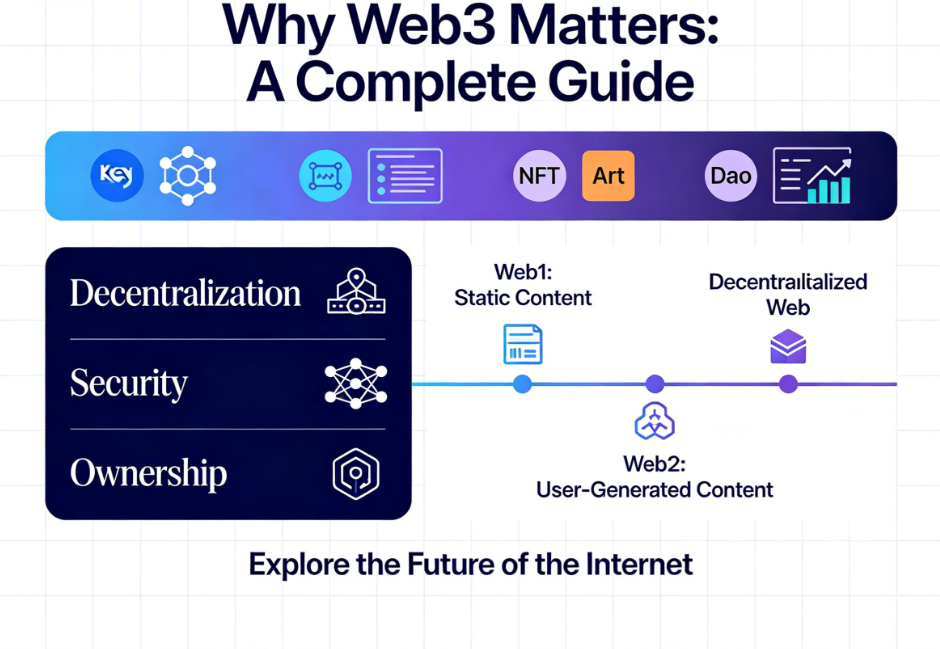
To grasp why Web3 matters, we must first look at the history of the web. The internet has undergone three distinct phases, each defined by how users interact with data.
Web1: The Read-Only Web (1990–2004)
In the beginning, the internet was like a massive digital library. It was decentralized in its infrastructure but limited in its utility. Users could log on and read information, but they couldn’t contribute. Websites were static, built by a small group of developers for a large audience of consumers. There were no social media feeds, no comment sections, and no user profiles. It was an era of information consumption, not creation.
Web2: The Read-Write Web (2004–Present)
Then came the revolution of interactivity. Web2 transformed the internet into a platform. Suddenly, anyone could be a creator. We started blogging, uploading videos to YouTube, and sharing our lives on Facebook. This era brought us immense convenience and connectivity.
However, this convenience came with a significant trade-off. To use these free platforms, we handed over our data. The infrastructure of the web became highly centralized. A few tech giants now control the servers, the algorithms, and the user data. They monetize your attention and sell your information to advertisers. In Web2, you are the product.
Web3: The Read-Write-Own Web (The Future)
This brings us to Web3. It retains the interactivity of Web2 but adds a critical layer: ownership. Web3 matters because it returns power to the individual.
Powered by blockchain technology, Web3 allows users to own their digital assets, data, and identity. You don't need to trust a corporation to keep your data safe; you trust the decentralized code. When you play a game in Web3, you own your in-game items as NFTs (Non-Fungible Tokens). When you post content, you own the rights to it. When you hold money, you are your own bank. This shift from centralization to decentralization is the core reason why Web3 matters.
The Core Pillars of Web3 Technology
Web3 is not a single app or website; it is a stack of technologies working together to create a trustless ecosystem.
Blockchain and Decentralization
At the heart of Web3 lies the blockchain. A blockchain is a shared, immutable ledger that records transactions across a network of computers. Because the ledger is distributed, no single entity can alter the data or shut down the network.
For Vietnam, a country with high internet penetration but a developing traditional financial infrastructure, Web3 benefits for Vietnam are profound. Blockchain offers a transparent and efficient alternative to traditional systems. It eliminates the need for trusted intermediaries, reducing costs and increasing speed. You don't need a bank to send money across borders; you just need a wallet and an internet connection.
Smart Contracts
Smart contracts are the engine of Web3. They are self-executing contracts with the terms of the agreement directly written into code. Think of a vending machine: you put money in, select a product, and the machine automatically delivers it without a shopkeeper.
Smart contracts work the same way but for complex digital agreements. They can automate loans, insurance payouts, or royalty distributions for artists. This automation removes human error and bias, ensuring that agreements are honored exactly as written.
Digital Tokens and Assets
Web3 introduces the concept of tokenization. Everything from currency to real estate can be represented as a digital token on a blockchain.
- Cryptocurrencies: These are digital currencies like Bitcoin and Ethereum that act as a medium of exchange and store of value.
- Utility Tokens: These provide access to specific services within a blockchain ecosystem.
- Governance Tokens: These give holders voting rights in a Decentralized Autonomous Organization (DAOs), allowing them to shape the future of a project.
- NFTs: These represent ownership of unique assets, digital or physical.
Platforms like HIBT are essential in this ecosystem. They provide the secure infrastructure needed to buy, sell, and trade these diverse digital assets. By offering a gateway to the tokenized economy, secure exchanges empower users to participate fully in Web3.
Why Web3 Matters for Vietnam: A Local Perspective
Vietnam is not just watching the Web3 revolution; it is leading it. We consistently rank among the top countries globally for cryptocurrency adoption. But why does this technology resonate so deeply here?
Financial Inclusion and Freedom
A significant portion of the Vietnamese population remains unbanked or underbanked. Traditional banking can be slow, expensive, and inaccessible to those in rural areas. Web3 democratizes finance. Anyone with a smartphone can access global financial services.
Through Decentralized Finance (DeFi), users can lend, borrow, and earn interest on their assets without needing a credit score or a bank account. This financial sovereignty is a massive driver of adoption.
The Gaming Revolution (GameFi)
Vietnam is arguably the global capital of GameFi (Game Finance). The phenomenon of "Play-to-Earn" took root here, showing the world that gaming could be an economic activity, not just a pastime.
In Web3 gaming, players truly own their digital items. A sword won in a game is an NFT that can be sold on an open marketplace for real money. This has created new income streams for thousands of young Vietnamese people, turning digital skills into tangible livelihoods.
Transparency and Trust
Trust is a valuable currency. In supply chains, real estate, and charitable giving, verifying authenticity can be difficult. Web3 offers a solution.
Imagine scanning a QR code on a bag of coffee beans and seeing its entire journey from a farm in Da Lat to a cafe in Hanoi, verified on a blockchain. This level of transparency boosts consumer confidence and adds value to Vietnamese products in the global market.
How to Start with Web3 Safely
Entering the world of Web3 can be daunting. The terminology is dense, and the risks are real. However, with the right approach, anyone can navigate this space securely. Here is how to start with Web3 safely.
Step 1: Secure Your Digital Identity (The Wallet)
Your journey begins with a crypto wallet. This is your passport to Web3. It stores your private keys—the cryptographic proof of ownership for your assets.
There are two main types:
- Hot Wallets: Software apps connected to the internet. Convenient for daily use but more vulnerable to hacks.
- Cold Wallets: Physical hardware devices that keep keys offline. Highly secure and recommended for long-term storage.
Crucial Tip: Never share your seed phrase (the recovery password for your wallet) with anyone. If you lose this, you lose your assets.
Step 2: Choose a Reliable Gateway
To acquire your first digital assets, you need a bridge between fiat currency (VND) and crypto. This is where centralized exchanges play a vital role. You need a platform that prioritizes security and compliance.
HIBT is designed with this need in mind. We provide top-tier security with advanced encryption technology and multi-layer risk controls, ensuring every transaction is fully protected. Whether it's your assets or personal data, we prioritize security to give you peace of mind with every trade. Choosing a platform that understands the local market and offers robust support is essential for a safe start.
Step 3: Education and Due Diligence
Web3 is rife with opportunities, but also scams. Before investing in any token or connecting your wallet to a site, do your homework.
- Research the Team: Who built the project? Are they reputable?
- Read the Whitepaper: Does the project solve a real problem?
- Check for Audits: Has the code been verified by security experts?
Step 4: Start Small
Do not rush. Start with a small amount of capital that you are comfortable experimenting with. Use this to learn how to send transactions, how to swap tokens, and how to interact with dApps (Decentralized Applications). Experience is the best teacher.
Web3 Investment Strategies for Experts
For the seasoned investor, Web3 offers a new frontier of asset classes and investment vehicles. Moving beyond simple "HODLing" (holding assets long-term), here are advanced Web3 investment strategies for experts.
Yield Farming and Liquidity Provision
In DeFi, you can put your assets to work. By providing liquidity to a Decentralized Exchange (DEX), you earn a portion of the trading fees. This is known as liquidity mining. While lucrative, it comes with the risk of "impermanent loss," where the value of your deposited assets changes relative to holding them in a wallet. Expert investors carefully calculate these risks against the potential yields (APY).
Governance Participation
Many Web3 protocols operate as DAOs. By holding governance tokens, you can vote on critical decisions, such as fee structures or treasury allocations. Active participation in governance can be an investment strategy in itself. It allows you to influence the direction of the protocol to favor your long-term interests and often comes with rewards for active voters.
Layer 2 and Infrastructure Plays
Ethereum struggles with scalability, leading to high fees during peak times. This has given rise to Layer 2 scaling solutions like Arbitrum and Optimism, which process transactions off-chain for a fraction of the cost. Investing in the infrastructure that makes Web3 faster and cheaper is a strategic bet on the technology's mass adoption.
Identifying which scaling solutions will capture the most value requires deep technical analysis and market insight. Platforms like HIBT offer a variety of cryptocurrency trading options, including spot trading, futures contracts, and margin trading, allowing you to adapt to market fluctuations and seize more investment opportunities like these. Whatever your trading strategy is, we have the solution for you.
Investing in the Metaverse
The Metaverse represents the convergence of our physical and digital lives. Investing in virtual real estate or the tokens that power these virtual worlds is a high-risk, high-reward strategy. It requires understanding user behavior, digital scarcity, and the potential for these platforms to host commerce and social interaction in the future.
Case Study: Supply Chain Transparency in Agriculture
Let's look at a practical example of why Web3 matters in Vietnam. The agricultural sector is a pillar of the economy, but it faces challenges in traceability and fair pricing.
A pilot project involving Vietnamese fruit exporters utilized blockchain technology to track produce. Each batch of fruit was assigned a digital token on a blockchain. As the fruit moved from the farmer to the packer, to the shipping container, and finally to a supermarket in Europe, each step was recorded on the immutable ledger.
The Result:
- Trust: European consumers could verify the origin and freshness of the fruit instantly.
- Efficiency: Paperwork and administrative delays were drastically reduced.
- Fairness: Farmers received faster payments through smart contracts that triggered automatically upon delivery verification.
This is not science fiction; it is Web3 in action, solving real-world problems and creating tangible value.
The Future: Where Do We Go From Here?
Web3 is still in its infancy. We are in the "dial-up" phase of this new internet. The user experience can be clunky, and the technology is still scaling. However, the trajectory is clear.
Interoperability
Currently, many blockchains operate in silos. Bitcoin doesn't easily talk to Ethereum. The future lies in interoperability—a seamless web where assets and data flow freely between different networks. Cross-chain bridges and protocols are being built to connect these islands into a unified continent.
Improved User Experience (UX)
For Web3 to reach billions of users, it needs to become invisible. Users shouldn't need to know they are using a blockchain, just as you don't need to understand TCP/IP to send an email. We will see the rise of "account abstraction," where wallets become easier to recover and use, removing the terrifying responsibility of managing seed phrases alone.
Regulatory Clarity
As the industry matures, governments are developing frameworks to regulate digital assets. While regulation can be challenging, clear rules will ultimately bring legitimacy and stability to the space, encouraging institutional investment and mass adoption.
Conclusion: Embracing the Ownership Economy
Why does Web3 matter? Because it represents a shift from being a passenger to being a driver. It offers a vision of the internet that is more open, transparent, and equitable. It empowers creators, protects privacy, and democratizes finance.
For Vietnam, the potential is limitless. We have the talent, the energy, and the hunger to be global leaders in this space. Whether you are a developer building the next great dApp, an investor backing the infrastructure of tomorrow, or a user exploring new digital freedoms, you are part of this revolution.
The journey into Web3 requires curiosity and caution. Equip yourself with knowledge, secure your digital identity, and choose partners who prioritize your safety. HIBT is committed to building a simple and intuitive trading platform, making it easy for both beginners and experienced traders to navigate. From a clean interface to powerful trading tools, HIBT ensures that every user can manage and trade digital assets effortlessly.
The future of the internet is being written right now. Don't just read about it—own a piece of it.
About the Author
Dr. Thien Nguyen
Dr. Thien Nguyen is a leading researcher in distributed systems and cryptographic security. With over 15 years of experience in computer science, he has authored more than 30 peer-reviewed papers on blockchain consensus algorithms and decentralized network architecture.
Dr. Nguyen has served as a lead technical auditor for several major Layer-1 blockchain protocols, ensuring the security of billions of dollars in digital assets. He is a frequent keynote speaker at international tech conferences and advises various governmental bodies on digital transformation strategies. His passion lies in bridging the gap between complex technology and everyday users, empowering individuals to take control of their digital sovereignty.